 On 6 April 1917, the United States’ patience with the Central Powers ran out and President Woodrow Wilson asked for and received a declaration of war from Congress. After almost three years of sitting neutral on the sidelines, America was a combatant in the Great War.
The great irony is America didn’t really want to get into the war. Unlike Franklin Roosevelt in 1941, Wilson had campaigned for the 1916 Presidential election under the slogan “He kept us out of war!” Unfortunately, circumstances overseas eventually made neutrality impossible.
Probably the greatest factor to draw the US into the war was Germany’s resumption of unrestricted submarine warfare in February 1917. After two years of scrupulously leaving neutral shipping, including American shipping, alone, the German High Command felt pressured by many factors, including the continuing British naval blockade of Germany, to resume the practice of sinking ANY ship via submarine found traveling in what the Germans designated war zones. In practice, this meant American ships started sinking any time they were found near the British Isles. Germany even went so far as patrolling outside American harbors for ships bound with material for Britain.
In the interest of honesty, America was in a poor position to cry foul over the submarines. Ostensibly a neutral, she was bound by rules of war not to carry armaments and other shipments to trade with and aid EITHER side in the conflict, yet from the war’s early days, American shipping magnates and manufacturers largely ignored the rules and carried on taking huge amounts of supplies across the Atlantic to Britain. One famous example was the Lusitania back in 1915. The sinking of this large ocean liner off the coast of Ireland nearly brought America into the war then because our government felt Germany had violated American neutrality. Since then, however, proof positive surfaced that the Lusitania, in addition to carrying passengers, had a hold full of ammunition destined for British guns. It’s not like Germany was sinking completely “innocent” ships despite the often high collateral damage.
So, unrestricted submarine warfare was a major cause of America’s move towards war, but it was not the ultimate factor. The final proverbial straw which broke the back of America’s patience bearing camel came in the form of the infamous Zimmerman Telegram. On 19 January 1917, Arthur Zimmerman, head of the German Foreign Office sent a telegram to the German Embassy in Washington, DC which was forwarded to the embassy in Mexico City, Mexico offering a sweet deal to the Mexican government. The entire text of the telegram read:
We intend to begin on the first of February unrestricted submarine warfare. We shall endeavor in spite of this to keep the United States of America neutral. In the event of this not succeeding, we make Mexico a proposal of alliance on the following basis: make war together, make peace together, generous financial support and an understanding on our part that Mexico is to reconquer the lost territory in Texas, New Mexico, and Arizona. The settlement in detail is left to you. You will inform the President of the above most secretly as soon as the outbreak of war with the United States of America is certain and add the suggestion that he should, on his own initiative, invite Japan to immediate adherence and at the same time mediate between Japan and ourselves. Please call the President’s attention to the fact that the ruthless employment of our submarines now offers the prospect of compelling England in a few months to make peace.
Signed, ZIMMERMANN
It wasn’t an altogether unusual step for a foreign government to try wooing allies during wartime; it’s actually a common practice. Unfortunately in this particular circumstance Germany made a fatal oversight. Unbeknownst to them, earlier in the war, British Intelligence Services had broken the German military ciphers used to encrypt the message. Secondly, since no German telegraph lines remained intact at this stage in the war, the message would have to go across the AMERICAN transatlantic telegraph cable. This cable just happened to run through a BRITISH relay station on its way to the United States. What neither Germany nor America knew at the time was British Intelligence had tapped said cable and recorded all traffic between Berlin and the embassy in Washington, DC.
Britain intercepted and decrypted the message, of course, and realized they were sitting on a bombshell that could finally get America into the war on the Entente side. However, they couldn’t do anything with it at the time because to take the cable straight to Wilson would be admitting Britain had been spying on American telegraph transmissions at least since the beginning of the war. A cover story was needed and lo and behold, one appeared shortly after Germany resumed the unrestricted submarine warfare.
When Germany loosed her submarines, America broke off diplomatic ties with Germany. Britain, who had been sitting on the telegram for a couple of months now saw the chance to act. They gave American intelligence services the decrypted telegram claiming a British spy had stolen a copy of said telegram in Mexico City. Still, all was not lost for Germany. A large section of the American population, mostly Irish-Americans and German-Americans, were wary of and disliked the British and vocal members of those contingents at first claimed the document had to be a forgery by British Intelligence trying to goad America into the war. For a few weeks, it looked like they were swaying the rest of popular opinion since such a large swath of the country was so determinedly anti-war.
Thing is, that might have worked had German Foreign Secretary Zimmerman not seriously put his foot in his mouth and given a speech in the Reichstag and ADMITTED the telegraph was genuine. This speech took place on 29 March 1917. Once the telegraph was confirmed genuine, the dominoes fell in America rather quickly, culminating in Wilson’s request for a declaration of war which Congress granted on 6 April 1917.
At long last, America was in the war. Undermanned and completely unprepared, but nonetheless in the war. The Yanks were going “over there.”
Love y’all and keep your feel clean.

 This past weekend, 330 wrestlers from all over the country competed in the 2017 NCAA Championship Tournament. My favorite college wrestling team, Penn St., won the team title by a large margin, helped by the strength of five individual champions. The Penn St. wrestler who impressed me most this year, however, never stepped on the mat at Nationals. He was the one Nittany Lion who did not qualify for the tournament. His name is George Carpenter.

 I wrote this a couple of years ago when the FIRST Fifty Shades movie came out and since its equally vapid sequel has just hit the screens, I thought it would be a good time to rerun it.


 It didn’t take long looking at the killing fields of the Western Front in 1914-1916 for some commanders at all levels to think, “We have to find a better way.” The whole idea of flesh and blood men jumping out of the scant protection of the trenches to run across the shell cratered and machine gun swept No-Man’s Land was obviously insane and yet, what to do about it?

 Some friends and I went to see Rogue One over the weekend and it was an extremely enjoyable movie. I recommend it to Star Wars fans who can appreciate all the plethora of “easter eggs” the movie has buried in it. Still, anytime I go to a Star Wars movie, the experience is always tinged with sadness. Whenever I see those blue words on the starry screen “A long time ago in a galaxy far, far away. . .” I am instantly transported to a time when I was young and innocent . . . and my world was beginning to fall apart.

 Twenty years ago when my Papa Wham died, I had my first encounter with the funerary business. Daddy took Granny and Aunt Cathy to Cannon’s Funeral Home to make the arrangements and pick out the things for Papa’s funeral. My little brother and I went along. I remember when we were picking out caskets, Nick and I both took a liking to a solid oak casket with satin lining. We thought Papa would have looked wonderful in it. We were both hurt when Daddy nixed our choice for a plain, gunmetal grey metal casket. Honestly, I thought it looked cheap. That’s when I learned my first lesson about funerals.

 Today is Tuesday. For the last three years Tuesday has meant one thing to me above all else — a ride down to Clinton to check on Granny in the nursing home. My routine changed earlier this month. November 1st, when I would normally be on my way home from NHC, I was sitting in the family room of Fletcher’s Funeral Home planning Granny’s funeral.


 I never parted from Mama if we were mad at each other. From the time I could drive I would threaten to follow her to work if we didn’t fix whatever lay between us. As a result, when the day came going on four years ago now and I had to stand over her casket, I felt grief — crushing grief –; I felt profound loss; but what I did not feel was regret. I’m not saying this makes me a great son or a great person because it doesn’t. I’m saying it because I haven’t followed the “no regrets” program with everyone in my life.

 Stardate 8 September 1966 a little known and lesser heralded science fiction show debuted on CBS. This little one hour space drama would only last three seasons — less than 100 episodes — but it would change the lives of countless people then yet to be born. Of course the show was Star Trek, known in Trekkie parlance as The Original Series or TOS to distinguish it from Star Trek: The Animated Series (TAS); Star Trek: The Next Generation (TNG); Deep Space Nine (DS9); Star Trek: Voyager (VOY); and, most recently, Star Trek: Enterprise (ENT). Anyone on the set back then would have been dumbfounded to know they were kicking off a bona fide cultural phenomenon and fifty years, six (soon to be SEVEN) TV series, and thirteen feature length movies later, Star Trek would be an actual way of life for some people. All you have to know is the Holy Bible is available in Klingon.

 I discovered Star Trek during the summer between fifth and sixth grade, a period I like to call the Babylonian Exile, when I was a lonely, bereft kid living in Columbia, SC for what seemed like the longest three months of my life. I was flipping channels . . . by hand, no less . . . and I saw a green girl dancing. I stopped and by the end of the episode, I was a devoted fan. I fell in love with Star Trek before I discovered Tolkien and Middle Earth, which is still hard for me to believe since I favor fantasy over science fiction these days. I spent every 3:00 hour that summer parked in front of the TV watching my new heroes Kirk, Bones, and Spock battle Klingons and Romulons . . . and each other more than once. When we moved back to the upstate, I was delighted to find the show came on up here, too, and at 7:00 so I could watch it during the school year as well. For those of you tender youths who wonder why I didn’t just “DVR” it, at the time VCRs were a bit in the future and anyone proposing something like commercial free television on a “hard drive” would have been burned at the stake as a witch.

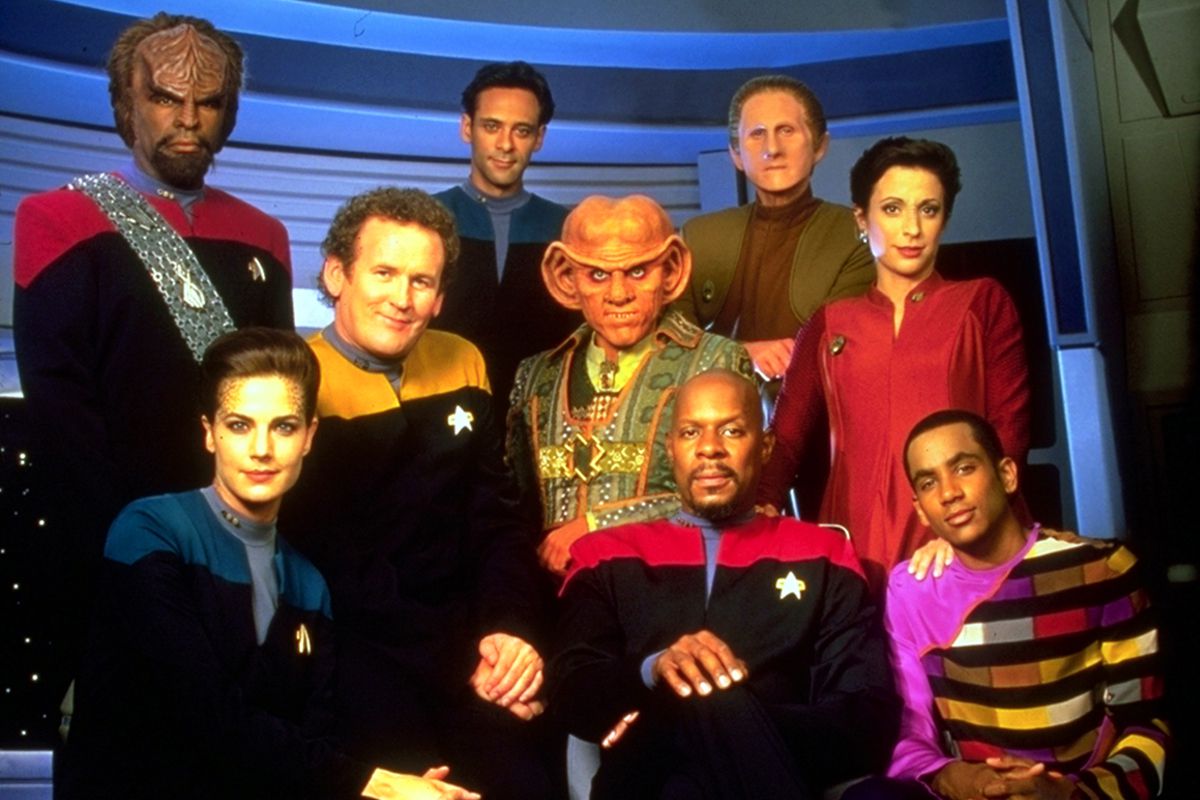 episode. I’d be a happy little camper then.
 one thought the way the writers rebooted the series while still maintaining continuity with the old timeline was genius. I know a lot of people wanted to scream deus ex machina, but hey, it worked . . . even if we did get a new Spock slightly more disposed to emotion. I’m not bucking any trends, however, when I claim The Wrath of Khan as being my favorite of the movie series. Spock dying to save the ship gets me every time AND it sets up the next few movies where Kirk steals a ship along with the rest of the gang, who even at this juncture are NOT as young as they used to be, in order to go find their friend.


