
The Liege Medal awarded to the 1914 defenders of Liege’s forts
Germany had been spoiling for a war — with France especially — for over twenty years leading up to World War I. Unfortunately, given her position in the middle of Europe, any war was likely going to be a two-front affair and anyone who studies military history knows two-front wars are the nightmare of any nation’s military intelligentsia. With such a dire prospect looming, the German military’s High Command, led by mostly Prussian aristocracy (think “Von” this and “Von” that), had developed a plan designed to make a two-front war not only winnable, but relatively simple. Officially, the plan was called Aufmarsch I West but those who study The Great War usually refer to it by the name of its principle designer and call it “The Schlieffen Plan.”
As several libraries worth of books and articles are floating around about the Schlieffen Plan, I’m not going into any great detail here, but the gist of the plan was thus: all along the border with France, Germany would maintain a token force to keep the French honest. Meanwhile, a huge force several armies strong would march from Germany’s heartland through neutral Belgium and come crashing down on the flank of the entire French border. This “sledgehammer head” force would push down all the way to Paris too quickly for the French forces on the border to react, Paris would fall, and France would be knocked out of the war at which point the bulk of German troops would pile on trains and head across France and Germany to engage the Russian Empire’s forces which would be just beginning to mobilize . . . theoretically.
The action would take place so fast and with such precision the British Empire would not have time to field a force and once France fell and Russia was neutralized, Kaiser Wilhelm II was certain his favorite first cousin King of Great Britain George V would figure any attack would be a waste of lives, resources, and –most dear to “a nation of shopkeepers” — money, and the two grandsons of Queen Victoria could divide the Old World amongst themselves. The plan was quite thorough, right down to timetables of trains leaving from thus and such a station and this or that corps arriving at just such spot in France. It was a fantastic plan, theoretically, but German High Command chose to overlook the sage advice of one of their country’s greatest military minds of the previous generation, Field Marshall Helmuth von Moltke the Elder who famously said, “No battle plan survives the first contact with the enemy.”
For the Schlieffen Plan to be successful, German forces had to get through neutral Belgium with alacrity. In all the wargaming and planning leading up to 1914, High Command felt 48 hours would be sufficient to traverse the little country. What’s more, they counted on using Belgian roads, bridges, and railways to speed the sledgehammer head’s advance into the French heartland. Unfortunately for Germany, in all their years of careful planning, they’d failed to let the Belgians know they were expected to lie down and allow the jackbooted German war machine to pass unhindered through their homeland. Germany would pay for that oversight in blood.
On August 1, 1914, Germany sent Belgium a diplomatic ultimatum announcing Germany’s intention of passing through Belgium and demanding the Belgians not resist militarily, leave all bridges and railways intact, and get all civilian traffic off the country’s roads to expedite passage of German soldiers. The Belgian government responded with some awesome variation of “up yours” and proceeded to dynamite all the bridges over the rivers and all the locomotives and tunnels in the country before putting up barriers all over every road leading into Belgium from Germany. Then, the Belgians manned their ring of forts leading into the interior and waited.
As soon as German troops entered the country, Belgian reservists and even some civilians began harassing the columns during their march. Many German soldiers fell to snipers in the thick hedgerows and along the stone walls of the farm country. The first real test of the German war plan came on August 6 when the German forces attacked the heavily fortified city of Liege. Before attacking, German commander General Otto von Emmich sent an envoy to the commander of the forts under a flag of truce. He demanded the Belgians surrender the forts and stand aside. The fortress commander’s name has been forgotten, but his ballsy reply has not, “Frayez-vous le passage, Messieurs!” (“Gentlemen, you must fight your way through!”)
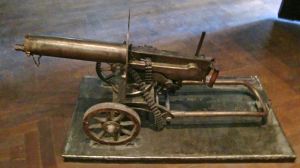
The Germans started the attack with a good old frontal assault figuring the Belgians wouldn’t have the stomach to repel such an attack. They found out it’s pretty easy to stomach any attack when you’re behind two foot thick concrete and steel walls and you’ve got a plethora of machine guns at your disposal. In a surreal scene which was to repeat itself all too many times in the following four years, German soldiers charged uphill at the forts and Belgian machine gun positions opened up on them. Thus the Germans were the first in the war to discover the equalizing power of Mr. Hiram Maxim’s invention.
The gallant Belgians held the German advance stalemated until August 15 knowing all the while help was not coming from France or Britain. They might have held on longer, but on August 12, the Germans brought up huge artillery pieces like 17 inch coastal battery guns via railroad. Once those guns were in place, it was just a matter of time. The forts of Liege were designed to repel any caliber of small arms fire and even the standard field pieces of their era, but the guns the Germans brought to bear were anything but standard. Within hours of setting the guns up, they began raining shells the size of small cars down on the brave defenders. Some of the forts caught fire and those that didn’t had their walls systematically reduced to flat rubble. The Belgians had fought bravely and punched far above their weight in this opening act of the war, but in the end they had no answer for the super-heavy artillery and the country fell to the invaders on August 17, fifteen days longer than the Schliefen Plan demanded.
The Belgian resistance wasn’t in vain. The fifteen days they held out enabled the British Expeditionary Force to land and dig in in good order just across the border and the French had precious time to mobilize reserve forces and move better troops into position to blunt the coming assault. The tiny country of waffles and chocolate may have been overlooked by the German war planners, but they gave their allies a precious commodity in war — time.
Love y’all, and keep those feet clean!

 Budge and I went with Deuce, Cameron, and the kids to see Guardians of the Galaxy tonight. Since Sunday is our 18th anniversary, we decided to make it our “anniversary date.” All told, it turned out great. Guardians may very well be one of my favorite movies ever. What made this movie so special is it grabbed me by the feels in the opening scene and for the next two hours and change, it did something only a tiny cluster of movies have ever done — it made me forget.

 Changing therapists resembles remarrying after a divorce or a spouse’s death. You lose someone who knows the most intimate details of the inside of your head, where all your buttons are to push, and the roots of all your issues lie and must start over from “Hi, I’m . . . .” with a complete stranger. It’s difficult at best and psychosis inducing at worst, which — come to think of it — really does make the marriage analogy apropos.




 I could cut out everything I love to eat — red meat, ice cream, starches, sweets, cheese, etc — and I could exercise religiously like I see so many people doing around here, but WHY would I want to? Perfect health is


 A long time ago at a drive-in theater long since buried under an I-85 interchange, a great adventure took place. It was the summer of 1977 and I sat on the roof of Mama’s 1973 Pontiac Grand Prix hugging a speaker and watching


 I’m hurrying to get this down. I fear it may be the last missive I write for a long time, maybe ever. If this be my last communication to the readers I love, know I did not faint nor flag in the fight. I pressed onward, met my enemy, and conquered him, but every victory has a price and this one is no different. In my zealous prosecution of the conflict, I have angered ancient foul beings of immense power and no mercy. I broke a sacred vow nearly two decades old. Now the cold hand of panic, raw gnawing terror grips me as the focus of their wrath turns towards me in its fullest. Already my fingers stiffen, my lower back is beginning to lock up, I cannot lift my arms above my head, my legs are in such knots I dare not attempt to poop for fear I may not be able to stand up from the toilet. These eldritch abominations possess long memories and when they are trifled with, they will have blood.



 I grew up in a Christian home and for the first 35 years of my life, give or take a year, I didn’t question my beliefs, what I’d been taught, or the basis of Christianity in general. I probably didn’t spend the total of a single day reflecting on whether or not this was true and that false or what the true purpose of life was. The weightiest discussions I had were on the relative merits of different “flavors” of Christianity like Mama’s Fundamentalist Pentecostalism versus Granny’s Southern Baptist Sunday School lessons. Even when I was a rank heathen and behaved as such, I still had a good handle on how the world worked, Who was in charge, and what the end of all things was going to be. In due time, I made a profession of faith in Christ, and figured I’d punched my ticket to Heaven when I died. Budge and I went to the church where we’d been married and worked diligently and tirelessly to further the kingdom of God on Earth.
 "Granny Beads and Grocery Store Feet"