
This document has slain tens of thousands in a century.
Anyone who has made even a cursory study of World War 1 knows the names Joffre, Von Moltke, Kitchner, Ludendorff, Hindenberg, and Pershing. These great generals . . . well, debatable, I know . . . managed to kill most of a generation of Europe’s finest young men. Their contribution to history is a long list of names of those killed and wounded engraved on monument after monument throughout Europe. Some enlisted men carved out their places in history during the Great War as well. These were infantrymen like Sgt. York of America, famous aerial warriors like Manfred “The Red Baron” von Richthofen of Germany, and poet extraordinaire Lt. Wilfred Owen of Great Britain. It is two men most people probably have never heard of, however, who cast the longest shadow of the First World War. While they may be relatively unknown to all but the most dedicated historians, Englishman Mark Sykes and Frenchman Francois Georges-Picot, by their actions following the Armistice of 1918, gave birth to men like Saddam Hussein, Ayatollah Khomeini, Osama bin Laden, and the shadowy leadership of ISIS / ISUL.

Map of Late Ottoman Empire
For 624 years, the Ottoman Empire was a major power in Eurasia. At its height, it ruled all of Asia Minor, Africa from the Straits of Gibraltar to the Horn of Africa, and Europe from the Balkans nearly to the gates of Vienna — an area which dwarfed the vaunted Roman Empire and compared favorably in size to even the mighty Mongol Empire of Genghis Khan. In the early centuries of its existence, the empire and its millions of available soldiers were the bogie-men of European children. The evil of “The Turk” was a tale told to keep little ones safely inside at night. From his palace in Istanbul, nee’ Constantinople, the Ottoman Sultan ruled a cosmopolitan kingdom of great riches, enormous resources, and surprising tolerance for non-Muslims. Unfortunately, those glory days were far faded by the outbreak of World War One. The Ottomon Empire had been “The Sick Man of Europe” for nearly a century before Sultan Mehmed VI signed a treaty with Germany and Austro-Hungary as much out of desperation as any grand design.
 The Ottoman Theater of World War I is fascinating in its scope and grandeur. Filled with places like Gallipoli and inhabited by men like T.E. “Lawrence of Arabia” Lawrence, the Middle Eastern theater deserves more scholarship than it has received, but it is not what happened as the Turks fought which has cause so much horror in the 21st Century as what happened once they were defeated. Throughout its history, the Ottoman Empire was home to hundreds of tribes and nations. Mostly Muslim, the Empire was generally tolerant of Christians and Jews living within its borders, several famous pogroms nonwithstanding. What is most important, however, is the government in Istanbul maintained a strict SECULAR stance on governing the Empire. Mark Sykes and Francois Georges-Picot shot that all to Hell when they signed the eponymous Sykes-Picot Agreement in 1916 even as millions were still dying. That agreement dictated how the Ottomon Empire would be carved up by the victorious Allies (confident pair, I must say) and, indeed, it was used to create the map we recognize today as the modern Middle East where everyone pretty much hates everyone else.

Francois Georges-Picot

Sir Mark Sykes
Sykes and Picot were colonialism men through and through, steeped in the propaganda of Kipling’s “White Man’s Burden” and they brought that Eurocentric, nationalistic, colonial attitude with them to hammer out the post-War map of the Middle East. Being intellectual, educated men, they both shared a love of lines. Where Frost felt “good fences make good neighbors,” Sykes and Picot felt nice straight lines made good borders and since the area they were divvying up was just sand populated by mostly nomadic tribesmen anyway, why not stick with lines and angles? These men were Christians — supposedly — and not given to Islamic scholarship. They had no idea what a Sunni, Shi’a, or Wahhabi was and, moreover, they didn’t particularly care.
When Sykes and Picot finished their work, the foundations of five countries existed where NONE had existed before: Lebanon, Syria, Jordan, Iraq, and Palestine. These “areas” were not proper countries for several years following the agreement, but their roots are in the secret agreement. They were “mandates” which is a century old P-C term for “colony.” France held a “mandate” over Lebanon, Syria, and Jordan. Britain controlled Iraq and Palestine. To see just how violently the peace of World War I is affecting us TODAY, let’s take a look at just one of these countries: the current playground of ISIS — Iraq.
Iraq was never a country. It became a British mandate, The Mandate of Mesopotamia, in 1920 after the League of Nations ratified several treaties ending the War and dividing the spoils. Then, in 1932, Great Britain quite magnanimously granted “The Kingdom of Iraq” its independence. Then the problem with Sykes, Picot, and their damned straight line borders came to light. Saudi Arabia is another kingdom in the area. Ruled by the House of Saud, it has a long turbulent history, but a history nonetheless. Saudi Arabia is overwhelmingly Sunni, specifically Wahhabist Sunni. The other ancient country in the region is Iran, formerly Persia. Most of its inhabitants are Shiite. Both those countries are somewhat oppressive by Western standards, but they are pretty stable places. Iraq is home to three VERY distinct groups — Sunni, Shiites, and the very eclectic Kurds who have representatives of at least six religions in their midst. NONE of these people groups like each other and since 1932, they’ve been told not to consider themselves Shi’a, Sunni, or Kurd but IRAQI.
Turn on the news tonight and see how well that has turned out. Britain practically guaranteed Iraq would fail. They did this by placing a Sunni King over the country. Of the three groups, the Sunni are the minority. So for over eighty years, Sunnis held real power over Shiites and Kurds, both of whom absolutely HATED the government. The only reason the country didn’t fall completely apart was a string of strong-arm dictators culminating in Saddam Hussein who ruled from 1979 to 2003 when he discovered America giveth and America taketh away. He held the country together by killing anyone who got out of line. As soon as “Coalition’ **cough ‘Merican cough** forces unseated him, the Sunnis, Shiites, and Kurds went back to killing each other, a practice which has continued right up til today and shows no real sign of stopping.
So, when you see ISIS beheading American journalists on the nightly news, remember exactly who you have to thank for it — Sir Mark Sykes and Francois Georges-Picot — two mid level bureaucrats who lived out every bureaucrat’s dream of not just filing policy, but actually writing it. One hundred years later, the blood continues to drip from their hands. The leader of ISIS has even declared, “The Islamic State will not stop its blessed advance until the stain of Sykes-Picot is driven from this land!”
We have Sykes and Picot to thank for THIS.
Great job, guys.
Love y’all and keep those feet clean.


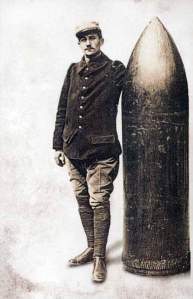 “If you want to make a lot of money, invent something that will enable these Europeans to cut each other’s throats with greater facility.” Unknown American to Hiram Maxim, 1881
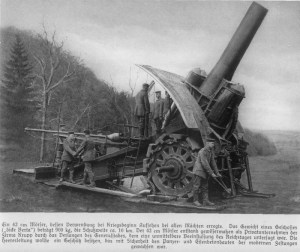 Taken together, these advances created the most awe inspiring weapons on the battlefields of World War One. During the American Civil War, the largest coastal defense guns fired a shell which weighed twenty pounds out to a maximum range of about five miles with a fire rate of one shot every three minutes by an expert crew. The workhorse of the French Army in World War One, by contrast, the French 75, could fire 15 rounds per minute at a range of five miles with 16 pound high explosive shells filled with mellenite, a particularly nasty explosive to men’s lungs.
 Osama bin Laden accomplished what he set out to do even though our SEALs killed him deader than John Edwards’ political career. He was a smart man — an asshole to be sure — but an intelligent man. I don’t think he believed flying those jets into our buildings 13 years ago today would destroy America. He knew about Pearl Harbor, so I’m certain he knew he was going to royally piss us off with his nasty sucker punch. He also knew what happened to the Empire of Japan once they pissed us off, too. He wasn’t trying to destroy our country . . . even now we are much too strong for anything approaching the end of America. So what if we go flat broke? We’ve got ten giant nuclear aircraft carriers afloat with three more being built as I write this. If ten carrier task forces can’t keep the bill collecting countries away, the 2,104 mushroom makers sleeping silently beneath the Midwestern prairie or lurking 150 fathoms down in eighteen underwater states most definitely will. Bin Laden and al-Queda brethren couldn’t destroy America so instead they did something much more sinister — they destroyed our way of life.
 The PATRIOT act and subsequent legislation has absolutely gutted the Bill of Rights, particularly the First and Fourth Amendments. In 1968, Chicago erupted in protests during the Democratic National Convention. These people gathered right outside the building housing the convention. Even today, images of Mayor Daley’s police force bludgeoning young and old, male and female alike with batons evokes a sense of the definition of police brutality. Of course, assemblies and protests like that are a relic now.



 It’s been six years since I left my career in education and I have a confession to make — even though I loved my students and did the best I could by them, I pretty much sucked at being a teacher and I wasn’t much better as a school librarian. It wasn’t for lack of trying or preparation; I joined NCTE and read English Journal faithfully the entire time I was an English teacher. When I was a librarian, I payed for School Library Journal out of my own pocket instead of using the school’s funds. I tried to help my kids and my fellow teachers, but I just didn’t have the gravity and ability so many of my colleagues did. My students never gave me any trouble and I always had one of the lowest discipline incident records each year, but I’ve never managed to shake the nagging feeling in the back of my mind — even after all this time — that I was subjecting students to a type of slow torture by force-feeding them Beowulf and Macbeth or short stories and poetry.




 "Granny Beads and Grocery Store Feet"