A Non-Ironic Christmas Miracle

Standard

https://i0.wp.com/acebos.xyz/wp-content/uploads/2015/12/Pictures-Of-Merry-Christmas.jpgI’ve been having a terrible holiday season. Thanksgiving was wonderful but ever since that glorious meal and day of hanging out with friends like family my mood and emotions have slowly and inexorably skidded towards a new nadir. I always write a Christmas post and honestly I had planned something even more cynical than last year’s. I feel like sandpapered bare nerves and figured I may as well take my massive (ha,ha) readership down with me.

Then, I some news rocked me back on my heels and got me to thinking beyond twinkling lights that keep blowing, decorations that never made it to the tree, and all the presents I couldn’t afford to buy this year. I got some news and it made me shut my cynical, downward spiraling mouth until I could open it in wonder and say to myself, “Damn, if that’s not Christmas, I don’t know what is.”

I’m leaving out all the names in this story because it is so highly personal to those involved. In doing so, however, I fear some may see my concern for another’s privacy as a cheap way of passing off a lie. If you believe I’m lying about this story, I pity you because you have grown more cynical and jaded than I have. I’m trying to protect the dignity of a person who doesn’t even know I exist and if you think that’s lying, I can’t help you.

This concerns the granddaughter of a precious acquaintance of mine. This sweet young lady whom I have only seen in pictures at my friend’s home is a freshman at a Midwestern college who currently attends said institution on a full scholarship. She comes from a wonderful family, had a reasonably good upbringing, got into the usual teenage mischief, but is overall a lovely young lady, if completely unremarkable in most ways. When I say she is unremarkable, I don’t mean she isn’t special or talented or she doesn’t stand out in any way, but she is much like the rest of her tribe of young college students. If I gave her name, it wouldn’t ring any bells to anyone outside her immediate family and circle of friends, I’m sure. In a very good way, she is simply average.

Several weeks ago, this wonderfully average girl was in her room studying for classes when her suite-mates announced their room was to soon become the epicenter of a spirited get-together. This lovely girl wasn’t too thrilled about having her study time interrupted by an impromptu party, but she realized those are the memory making moments of college which last so she didn’t protest much.

By-the-by, friends and acquaintances, classmates and dorm-mates began to arrive and a wonderful time of eating and listening to music, etc was had by all. Whether or not any underage drinking occurred is anyone’s guess but I can say with absolute authority the young lady in question emphatically did NOT partake of anything alcoholic, much less to extreme because her scholarship depends on an extremely high level of training and fitness and her coach does not tolerate hangovers.

So, at an appropriate hour, or maybe somewhat past, the suite-mates decide the gathering had run its course and started breaking up the festivities. Our girl walked a few friends out of the building then returned to her apartment, said goodnight to the few remaining guests and — claiming fatigue — retired to her bedroom where she changed into flannel pjs, crawled into bed, pulled the covers up and went soundly to sleep. When she awoke the next morning, she was in basically the same position, same clothes, same bed, same everything.

When she got up, she did notice she was really sore, but she didn’t think much of it because training for her sport had begun in earnest and a modicum of soreness was expected at this point in the season. When the ache went away by the next day, she didn’t give it anymore thought.

Fast-forward four or five weeks and she’s feeling a touch under the weather. Nothing terrible and she figures it might be her body adjusting to the new climate. Still, to be safe, she went to the infirmary where a very efficient nurse practitioner checked her out and took a blood sample before sending her home with an antibiotic.

Two days later, she got the call from the infirmary which would change her life and the life of her family forever. A lot of us think we’ve gotten such a call . . . this young woman did. The very efficient nurse practitioner was on the phone and basically ordered her to return to the infirmary . When she arrived at the clinic, she asked what the problem with her blood tests was. The very efficient nurse practitioner then point-blank informed this young lady all alone and miles from any of the support systems she knew and adored she was several weeks pregnant.

That was impossible she told the nurse. She absolutely couldn’t be pregnant because she was, in fact, a virgin. She didn’t even have a boyfriend! Somehow a mistake had to have occurred, but upon a thorough exam, she realized there had been no mistake. She was no longer a virgin. She WAS pregnant.

When the shock wore off enough for her to contact her family, her mother came out and along with her roommates they began to piece together what had happened. To cut a rapidly growing story somewhat short, this girl had been drugged or “roofied” at the party weeks before, stripped, raped while unconscious, then re-dressed and tucked back in bed as though nothing happened. What’s more, the roommates were certain of the culprit because he had apparently been accused of this action before.

Now, this girl and her family are solid Christians, but even so, the most staunch pro-lifers are against abortion “EXCEPT in the case of incest, rape, or danger to the mother.” OBVIOUSLY this was a case squarely in the “exception clause.” Of course she was going to have an abortion. The school even offered to pay for it for her so she wouldn’t be out any money. They would work on prosecuting the offender, but no one expected her to keep this child. It was a RAPE BABY! Everyone would understand. It was the right course of action to take.

Here’s where the story turns from anger inducing to miracle working. She said, “No.” Simple as that. NO. She wasn’t having an abortion. Furthermore, she is not giving the baby up for adoption once he or she is born. She plans to keep and raise her baby.

Obviously, to just about everyone around her this is nothing short of insane. She’s a freshman in college. How is she going to manage a baby as an unmarried single mom in school? What about her reputation? What about the father? What about the hundreds of other “What abouts” to consider? Well, she considered them and decided to have and keep her baby.

The university is working with her hand in glove. She’s being given a leave of absence until the baby arrives at which time a court ordered paternity test will take care of the question of the father. Her scholarship is safely intact. Still, nothing in her life is ever going to be the same. All the plans she had mapped out, all the hopes and dreams now have to be completely overhauled. She will endure ridicule and scorn from now on because in any crowd some people will always rush to believe the worst about someone. She’ll be accused of “asking for it.” Her life will be on trial even though she’s done nothing. Some people will claim she’s using the baby for monetary gain because the rapist father is the scion of a hugely prominent and wealthy family in that state.

From now on, no matter what she does, she’s going to carry a stigma. She’s going to be “That Girl,” but she’s also carrying a baby. I guess 999 of 1000 women or more would have gone with the abortion and WHO COULD BLAME THEM? To this girl, however, aborting the baby would be tantamount to blaming him (or her) for the heinous crime the father committed. She refuses to do that. The world sees a rape baby, fit for — at best — being given up for adoption.

She sees her son (or daughter) and THAT is what hit me so hard.

2000 years ago and half a world away, another lovely young lady, also completely unremarkable in most ways and also a virgin found out SHE was pregnant. She, at least, was warned by an angel, but I’m thinking it didn’t help much in the end. As soon as she began to show, tongues started flapping. Obviously she was a harlot! She must have done something to bring this on herself! Her betrothed had the right to have her killed by stoning, but he chose instead to just “put her away”, an euphemism for divorce. Another visit by another angel changed HIS mind and together they had that baby and the Apostle Luke says she wrapped Him in swaddling clothes and laid Him in a manger because there was no room in the local inn. They became a family right in the middle of a storm of scandal.

“The Holy Spirit?!” “Right!” “A VIRGIN!! Her?!” “Right.” That mother and her little baby were haunted by people who thought for absolute certainty they knew more than they did and weren’t afraid to spread their venom far and wide. Even today, 2000 years later, it hasn’t stopped. Scientists, philosophers, and great men of all stripes still say it couldn’t have happened. One major theory for all 20 centuries was this lovely young lady, completely unremarkable in most ways was raped by a Roman soldier, got pregnant, and tried to cover it up with the most unbelievable story possible and make herself the center of a new religion in the process because in any crowd some people will always rush to believe the worst about someone and refuse to believe otherwise.

By the way, spare me all the stories of the pagan roots of the Christmas celebrations — I know them, studied them, and even taught classes about them. I know, as do most thoughtful Christians, Jesus wasn’t born on December 25, 1 AD so save all your science and your scorn. Keep your bigoted opinions to yourself because I’ve been there, I’ve got the scars, and I bought the t-shirt with all that cynical drivel writ large upon it and I came to realize one thing:

Christmas isn’t about a date on a calendar; it’s about a babe in a manger. It’s not about the gifts we give each other but about The Gift a loving God gave to a world dying in sin; “For God so loved the world that He gave His only begotten Son and whosoever will believe in Him shall not perish, but have everlasting life.” So, to quote an adorable little cartoon guy with a red shirt and a blue blanket, “THAT’S what Christmas is all about, Charlie Brown.”

Love y’all, keep your feet clean, and have a very Merry Christmas.

It’s Time for the Force to Awaken

Standard

https://i0.wp.com/www.insidethemagic.net/wp-content/uploads/2015/10/Force-Awakens-poster-2-400x200.pngThis post is mostly a rerun, but with Episode VII: The Force Awakens hitting the theaters this week, it seems appropriate. I’m planning to see the film as soon as the initial insanity settles down a little. Crowds scare me more than they did when I was on top of that Pontiac almost 40 years ago now. I’m going to see this one though. I may even go to Greenwood where a nice drive-in theater is still operating. I think it would bring the whole experience full circle for me. I’ll let y’all know what I think as soon as I see it.

A long time ago at a drive-in theater long since buried under an I-85 interchange, a great adventure took place. It was the summer of 1977 and I sat on the roof of Mama’s 1973 Pontiac Grand Prix hugging a speaker and watching the huge Imperial Star Destroyer Devastator inexorably close in on the tiny, defenseless Tantive IV. Three years later, Daddy and Teresa took me to the now defunct Astro Twin on Pleasantburg Drive where I watched Luke Skywalker battle the evil Darth Vader right before the greatest plot twist surprise in cinema history. Then, as a high school freshman, Robby and I sat in the — once again, defunct — Oaks Theater in Laurens to see Luke reunited with his friends amidst a sea of dancing teddy bears.

Star Wars played a MONUMENTAL role in my childhood and the childhoods of a big chunk of my generation. To give you an idea of just what a cultural touchstone those films are to Gen-Xers everywhere, when I called one of my college roommates to tell him I was marrying a girl born in 1978, the first thought out of his mouth was not “Congratulations” or anything like it. Instead, Chris Hoppe shouted at me, “1978! Good God, Wham! She’s never seen Star Wars at the movie theater!” He was right, of course, so as soon as Budge and I left the theater in the summer of 1997 after watching the re-release of Star Wars: A New Hope, I called him up to let him know my beloved was now bona fide.

If some of you who are younger want something to compare the effect of the Star Wars movies and associated phenomena had on us who are now fortysomethings just think how you felt when you found out Harry Potter and the Sorcerer’s Stone was going to be turned into a movie and then waiting for each of the succeeding films. It’s pretty much like that.

Now, if George Lucas had possessed the sense to get a prenuptial agreement with his wife, the Star Wars universe would probably have remained the exclusive unsullied cultural icon for Generation X. Unfortunately, the erstwhile Mrs. Lucas took ol’ George to the cleaners financially leaving him in relatively bad straits — no small feat to nearly bankrupt a man responsible of Luke Skywalker AND Indiana Jones. So, rumors started flying around the newly-burgeoning internet about something none of us Baby Boomer Babies ever dreamed we’d live to see — George Lucas was going to MAKE THE PREQUELS!!

Whatsa pissa poopsa!

Whatsa pissa poopsa!

So it was I sat in Theater 6 of The Hollywood 20 Theater with Budge on May 19, 1999 and watched the familiar opening crawl wind its way up the screen. I was more excited about a movie than I’d ever been or ever would be . . . at least until 2001 when I waited in line for hours to get tickets to Lord of the Rings: The Fellowship of the Ring. I quickly lost myself in the film’s first fifteen minutes; I was a kid again on the roof of that ’73 Grand Prix. Then, out of the murky green depths of one of the many planets in the Star Wars universe, disaster overtook my beloved franchise. Jar-Jar Binks appeared on the screen. Since Jar-Jar hate is widely documented, I’m not going to waste your time adding my opinions, but let’s just say, when it comes to all the negative things said about the bumbling Gungan, “I concur and then some.” I was delighted and crushed when the movie ended — delighted it was finally over and crushed that I’d waited 22 years for such a turd to plop onto my lovely memories.

Again, to give you an idea, imagine they made the first several Harry Potter movies as you remember them then, for whatever reason, they replaced Daniel Radcliffe, Rupert Grint, and Emma Watson with Will Ferrell, Adam Sandler, and Tina Fey. It not only wouldn’t be the same, it would be a type of sacrilege bad enough to get one burned at the stake in Medieval Europe. Heresy is not too strong a word. I was in physical pain by the time Phantom Menace ended. My childhood didn’t just die on screen, it was hung, drawn, and quartered.

After Phantom Menace, I realized Lucas was just going for money so I didn’t bother to see Attack of the Clones or Revenge of the Sith. I figured it would be a waste of time. In all honesty, I do wish I’d seen RotS on the big screen though, just to see the climactic fight on Mustafar between Obi-Wan and Anakin, but since that’s the only part of the movie I care anything about, I’ve just learned to content myself with YouTube. As a side note, if the prequels hadn’t shown Lucas’ money-making bias, Indiana Jones and the Kingdom of the Crystal Skull proved to me he had completely blown up the refrigerator.

The cast . . .

The cast . . .

Well, Lucas sold the beloved space opera franchise to the ONE entity more concerned with money than he is — Disney. Less than a year after the sale, The Mouse has announced Episodes VII, VIII, and IX are in the works with Episode VII to be released next year, probably around Christmas. Today, the official casting announcements came out. The good news is Han, Luke, and Leia are all back aboard although I wonder if Harrison Ford will live long enough to finish all three films. The bad news is JJ Abrams is directing and co-producing Episode VII. So, this movie could be absolutely amazing with incredible visual effects and only slightly less boom and bang than a Michael Bay CGI-fest OR we could end up at the end of Episode IX discovering the entire nine film series actually took place in the imagination of some homeless Earth kid playing with broken action figures someone left lying in the park. To anyone who thinks I’m being silly and overreacting I can only reply with two words: Lost finale.

Hopefully though, the number of original cast members along with the addition of Gollum will pull the final three movies in the Star Wars nonology through. At least John Williams is doing the scores!

Love y’all and keep those feet clean.

Great War Wednesday: Looking Back on 1915

Standard
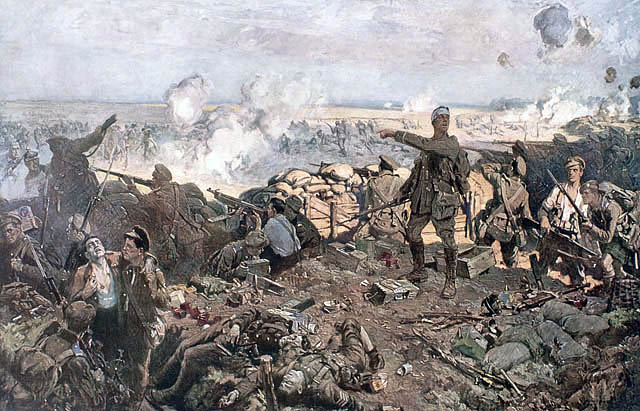
https://upload.wikimedia.org/wikipedia/commons/3/38/The_Second_Battle_of_Ypres.jpg

Painting of the Second Battle of Ypres, 1915

In many ways, 1915 is the redheaded stepchild of the Great War. It’s not that nothing happened during the year; a great many spectacular things took place such as the introduction of poison gas onto the battlefield, a ramping up of war in the air, and the perfection of trench warfare. It was also the year of several great battles, but none of them have yet attained the historical cachet awarded to other clashes.

This was the year the armies settled into the bloody, futile routine of trench warfare. No-man’s Land became a byword and propaganda fulled the fires of hatred between the British Tommies, German Fritzes, and Ottoman Johnny Turks. Most notably, when Christmas 1915 arrived, no one tried to meet in the middle of the wasteland between trenches for a friendly game of football. The war rolled on as usual; it was a time of tremendous bloodshed.

1915 saw Loos, Artois, Champagne, and 2nd Ypres become bloody battlefields on the Western Front while the East saw slaughter in the Caucasus Mountains and the historic Great Retreat of the Russians. The Ottoman Empire joined the war and Churchill convinced the Entente Powers to launch the monumentally disastrous Gallipoli Campaign which helped draw world attention away from the tragedy of the Armenian Genocide the Ottomans were perpetrating at the same time.

Italy joined the war when the Entente finally convinced her she would gain more in an Entente victory than if she threw in with the Central Powers. Shortly after her entry the First Battle of the Isonzo River made that alpine stream run red. Before 1915 ended, Italy and Austria-Hungary would fight the Second, Third, and Fourth Battles of the Isonzo and before the Armistice ended the War, these two enemies would fight SIX MORE battles up and down that river valley where trenches could only be dug with dynamite and rock shrapnel mixed with steel to increase the deadliness of any bombardment.

In the air, German Ace Max Immelmann began writing the book on aerial combat and though he would die in a hail of bullets and a flaming crash, his Immelmann Turn would outlive him and be the great legacy of the lonely Eagle of Lille. It was also in 1915 the Fokker Scourge utilizing the Fokker Eindecker single wing aircraft would drive the Entente pilots from the skies in droves and for a time, Germany held complete sway over the air.

On the seas, Germany unleashed her U-boats and they proved greatly effective so long as they refused to abide by standard rules of naval warfare and alert the ship they intended to sink. This “unrestricted” submarine warfare eventually lead to the sinking of the famous Lusitania British liner with the loss of over 100 American lives and very nearly brought America into the war three years before she would eventually join.

Other than the U-boats, however, the sea was generally a quiet place. Some commerce raiding took place on both sides, but the British Home Fleet and the German High Seas Fleet would both remain in port watching and waiting for some great encounter.

So 1915 was far from uneventful, but the actions of the year remain largely footnotes in the history of World War One not because they were unimportant, but because all the battles of 1915 paled in comparison to what was to come in 1916 — the year contemporary writers called “The Breaker of Nations.” 1916 would see the main great naval battle finally take place at Jutland, but most of all, it would be ruled by two words: Verdun and Somme.

This is the last Great War Wednesday post of the year. I’ll pick back up in January or early February to look at the events of 1916. Until then, have a great new year and keep your feet clean.

#TBT: Why I Wear Shorts and Crocs in Winter

Standard

This was originally published December 13, 2010 and for the record, I still wear only shorts and Crocs, even in winter.

I’ll be the first to admit that the inside of my head isn’t a place most people want to visit, much less live or even stay for a while. It gets weird in here at times, even for me and its MY head. I think strange things; not so much “bad thoughts” or “thoughts I shouldn’t think” as much as  “where the blazes do these thoughts come from?” I’m sensitive to odd things. Odd moments make me emotional. Strange things can make me cry.

I also do some strange things. They aren’t strange to me. In fact, they seem quite normal while they are in the planning stages inside my head, but when they break out into the open, they make people look at me oddly. I’ve rather gotten used to it.

I guess one of the strangest things I do — as far as others looking at me goes — is wearing my Crocs and shorts in the coldest weather, often with a short sleeve shirt and no jacket. Folks think this is strange behavior, and they are always asking me why I don’t wear a coat or why am I wearing shoes with holes in them and other, perfectly valid questions. Even though I wear Crocs all the time, they take on a special meaning in winter.

Yes, I do get cold. I am fat and so have a goodly amount of natural insulation and it helps more than you’d think, but my arms get cold and my legs get cold and sometimes, my feet are too cold to feel. Still, I’ve never told anyone before — not even Budge or Mama — why I intentionally let myself get very cold, to the point that sometimes it actually hurts.

Here’s why.

When I’m letting myself get cold, I’m reminding myself that, no matter HOW cold I get — how cold I LET myself get — I’m never going to suffer from the cold in any way as badly as others have. Enduring a tiny bit of frigid discomfort is my small, weird way of honoring those people whose memories lay like limestone blocks on my soul.

No matter how cold I get or how wet and frigid my feet get,  I’ll never be half as cold as the men — boys really — in the trenches of the First World War. My feet aren’t going to go numb and get frostbitten and develop trench foot. I’ll be going into a warm house or car shortly, not standing constantly in ankle-deep water that doesn’t freeze only because the constant movement of men keeps the ice broken up.

No matter how cold I get, I won’t be anywhere near as cold as the political prisoners of the Soviet Union’s GULAGS. I read A Day in the Life of Ivan Denisovich my first year as a teacher. It was hard. These were men, and some women, enduring the Siberian winter with nowhere near enough cold weather gear, working with bricks that would freeze to their hands. Not enough to eat, never warm for months at a time. Ice and snow everywhere, and all the time knowing you’re here because of your beliefs and principles — not any “crime.”

I read Night as a senior in college and I’ve never looked at cold the same since because God knows I won’t be as cold as the poor souls of Auschwitz, Majdanek, Mauthausen or the other hundreds of concentration camps spread throughout the Nazi Reich.

Every time I feel the cold, and especially the biting winds,  slashing into me so I feel myself trying to “draw in” for some relief, I see rows and rows of wretched men, women, and children standing on the appelplatz with snow on their shoulders and no shelter from the Polish winter winds. Standing in the elements, freezing to death for the unspeakable act of being born Jewish, Gypsy, Polish, or Russian.

I think of them trying to sleep on a wooden plank with a “blanket” — more of a worn bed sheet — for warmth, knowing through the winter blackness that dawn would bring no hope, no reprieve only more cold.

PLEASE understand I in no way claim kinship with the Shoah victims. Nothing I could inflict upon myself would approach the deprivations they endured, and certainly a few shivers and goosebumps can scarcely bring their suffering to mind, but I do attempt  to remember. And so, to honor their memory.

When I get bitterly cold, I know a warm shower, hot meal, and invitingly comfortable bed with mounds of warm quilts or an electric blanket await me just inside my home.

So, I know I’ll never fully understand the plight of the homeless in America’s cities, huddled about burning trash barrels, sleeping atop steam grates, stuffing their rags with newspapers — all the time trying to raise their temperature just a degree or so.

All the while enduring not only the biting cold, but also the biting stares of those who’ll never have to worry about their next meal or where they will sleep or what will happen to them if the temperature drops again tonight. Knowing that there, but for the grace of God, do I lie huddled while my fellow-men walk quickly past.

I’m trying to honor and remember these brave, damned souls who fought against Old Man Winter. From Valley Forge with its bloody footprints in the snow, to the bitter winters around the Chosin Reservoir and Inchon during the forgotten Korean War, to the Arctic and Antarctic explorers and all the snowbound, ice rimed humanity in between, in war and in peace, but always in cold.

Men and women, some fighting for God and king, some just down on their luck, many freezing to death far from home, but all denied the most basic human right — the right to be warm.

So that is why I often wear Crocs and shorts without a jacket in winter. It’s not much, but it’s the least I can do.

To give honor; to remember.

Love y’all and don’t forget to keep your feet warm, dry, and clean.

#TBT: Welcome to the World, Baby Boy!

Standard
https://grocerystorefeet.com/wp-content/uploads/2009/11/picture-003-e1258836162397.jpg?w=161&h=300

Mason Benjamin Wham, Age 27 hours

This post originally appeared November 20, 2010 when my little nephew was born. Today is his sixth birthday.

Ladies and gentlemen, may I be permitted to introduce the first new addition to the Frank B. Wham, Sr. branch of Whams in about 22 years! Meet Mason Benjamin Wham, the absolutely beautiful fruit of my younger brother, Nick’s loins and the result of the hard work of Kerry, my sister-in-law.

He is, of course, flawless in every way and has already scored perfect marks on all his newborn tests. Depending on who one asks, he arrived a week early (by Sissy’s account) or two weeks early (by Dr. Keller’s account). It’s actually a good thing he decided to come on and make his debut because as it was, he was 8 lbs. 7 oz and 20 inches long. A week or two more of floating around and growing and he would have been a hoss sure enough. As it is, he fits perfectly into the crook of an arm and weighs about the same as a large bag of sugar and is just as sweet.

Nick and Sissy brought him home today and I’ll need to be going over there before long to help get him settled in. In all likelihood, he’ll never see the inside of a day care since Nick’s mother, Teresa, is “conveniently” unemployed due to cutbacks at her former office. Daddy is absolutely about to explode with pride over his first (and if Sissy is to be believed, his last) grandchild. I think Teresa may have to sew new buttons on all of his shirts to replace the ones he burst upon Mason’s arrival.

One funny story about his birth. No one told my brother that babies don’t automatically start breathing as soon as they clear the birth canal; so, there he was coaching and waiting like a good new father when Mason pretty much popped into the doctor’s hands. According to Nick, “He was as blue as my blue jeans and he wasn’t breathing. I sank to my knees certain that my son was still born.” Luckily for all of us, a little suction at the nose and mouth and Mason announced his arrival into the world with a set of lungs that would have made his Granny Wham very proud. He also has no problems nursing and has shown a definite appreciation for George Jones songs.

I think he’s perfect.

And here he is six years later! Happy Birthday, little Red!


Veterans’ Day 2015

Standard

https://tce-live2.s3.amazonaws.com/media/media/a8dde221-64c3-48cf-b6d0-248d0ce4d539.jpgIn Flanders Fields
By: Lt. Col. John McCrae, MD (1872-1918)
Canadian Army

In Flanders Fields the poppies blow
Between the crosses row on row,
That mark our place; and in the sky
The larks, still bravely singing, fly
Scarce heard amid the guns below.

We are the Dead. Short days ago
We lived, felt dawn, saw sunset glow,
Loved and were loved, and now we lie
In Flanders fields.

Take up our quarrel with the foe:
To you from failing hands we throw
The torch; be yours to hold it high.
If ye break faith with us who die
We shall not sleep, though poppies grow
In Flanders fields
.

From one who has never known the smell of battle and the stench of blood and fear to every veteran of every American war, popular and unpopular, won or lost, concluded or continuing, thank you so much for risking your lives and many times giving your lives in the service of your country. You did not ask if the fight was a cause you believed in for it was enough that you believed in the country that gave the call.

Bless you, each and every one of you.

I’d wash all y’all’s tired feet if I could.

Thank you again. Love y’all.

Great War Wednesday: Heads Up

Standard
https://upload.wikimedia.org/wikipedia/commons/f/f4/French_soldier_early_uniform_WWI.JPG

Zouave in 1914 kit.

It’s a safe bet to say no one was ready for World War I. The last time Europe erupted in a continent-wide conflagration, a Corsican artillery corporal was the one who lit the flame. One hundred years of relative peace saw great progress in weapons technology, but other areas lagged conspicuously far behind. Nowhere on the battlefield was the state of general unpreparedness more obvious than the uniforms all the combatants marched off to war clothed in.

The French cavalry famously wore uniforms almost indistinguishable from those Napoleon’s famous cuirassiers had worn on the field at Waterloo. The French also fielded several of their Zouaves regiments still wearing their distinctive brilliant red flowing pantaloons in 1914 and 1915.

For their part, the British had learned from the Zulu Wars and the two Boer Wars how foolish their traditional bright red coats were on even a semi-modern battlefield. As a result of heavy casualties in those engagements, especially to officers, they wisely marched off to the Western Front wearing khaki colored kits. Unfortunately, while khaki is a marvelous camouflage in the Transvaal of Africa, it sticks out like a duck in a hen coop on the green fields of Flanders.

https://i0.wp.com/www.sofmilitary.co.uk/products/White%20French%20Kepi%20Hat%20291113%2001.JPG

The wool Kepi hat, standard issue 1914-1916

Brightly colored uniforms aside, all the combatants shared one flaw in their strategy for protecting their soldiers — no one wore helmets. Helmets or “helms” had once been the crowning piece of any worthy soldier’s kit. Knights of course wore elaborate face-encompassing tubs of metal, but even the lowliest archer or pikeman would have some sort of iron or at least boiled leather pot to guard his pate.

Unfortunately, the advent of gunpowder spelled the doom of the helmet. Commanders reasoned, quite logically, that any helm capable of stopping a bullet would prove entirely too heavy and cumbersome for soldiers to wear with any regularity. As a result, the substantial protective headgear gave way to more elaborately colored and beplumed “shakos” which enabled generals to keep track of their troops in the smoke and fog of battle. For 200 years, the helmet, if it was worn at all, was a ceremonial headpiece at best. So things stood at the outset of the Great War as the French marched off in their traditional white wool “kepis” while the Brits wore soft flannel field caps into the early battles.

https://i0.wp.com/snapshotsfromberlin.com/wp-content/uploads/2014/07/3-Prussian-Pickelhaube.jpg

The distinctly Prussian pickelhaub

By the middle of 1915, however, trench warfare had set in in earnest and officers began noticing a new type of injury causing great casualties among the men. Whenever the massive field guns’ shells exploded near the lines, they would fling great plumes of rock, soil, and shrapnel into the air — often to great heights. As men like Galileo and Newton proved throughout the centuries, what went up was going to come down . . . HARD. A man might not be harmed in the least by the blast from a Bertha, but the fist sized rock she kicked up falling from a quarter of a mile high onto his cute little kepi would do a number on the old brain pan. Helmets started making a rapid comeback.

The Germans were at the forefront of helmet development having been the only power to enter the war with some semblance of one already — the iconic “pickelhaub” with its prominent central spike. The spiked helm was more for looks, however, so the Germans began development on a three piece forged helmet with a modest visor and a defined skirt at the back protecting the wearer’s neck. This became the famous “stahlhelm” which would serve with distinction throughout the Great War and later be a symbol of the Nazi regime during World War 2.

https://i0.wp.com/www.monsmilitaryantiques.co.uk/myarchive/1456.jpg

A “B” pattern Brodie helmet.

Across the Channel, the British developed the Brodie Helmet which became the stereotypical look of the British infantry “Tommies” during the War. The Brodie, unlike the stahlhelm was stamped from a single piece of steel instead of being meticulous fitted together. As a result, the Brodie could be turned out in much greater numbers at a greater rate enabling the British Expeditionary Force to be fully fitted out with helmets before any other army.

The Brodie was a practical design which hearkened back to medieval yeomen’s helmets. It was a shallow dome covering the head and sported a wide brim all the way round designed to shield the neck and face from falling debris in the trenches. The first production Brodie helmets had a bit larger brim than the later standard models, but High Command realized through early trials that the wider brim made it difficult for the men to aim their weapons from a prone, or lying down, position. The Brodie would later become the standard helmet for America’s doughboys and dogfaces upon the United State’s entry into the war.

https://i0.wp.com/www.ultimatehistoryproject.com/uploads/3/0/6/7/3067335/5950063.png

French Adrian helmet of 1916

Other countries adopted their own versions — with modifications — of the stahlhelm and the Brodie depending on which side they were fighting. The French drug their feet the longest and it was actually the middle of 1916 before they exchanged their useless kepis for their version of the Brodie called the Adrian helmet which had a bit narrower brim but a more rounded cup over the head.

As soon as helmets started appearing in the trenches commanders noticed casualties from falling debris began to decline. In 1914 – middle 1915, the most common fatal injury was from falling projectiles. Once helmets appeared in sizable numbers, those injuries declined by two thirds and fatalities by around half.Of course, like their late medieval forebears, none of the helmets would stop a bullet, but such was not in their design. Instead, they kept the rocks and mound of dirt the guns kicked up from cracking the skulls of the men ducking down in the trenches.

One thing both sides had in common was that, while all of the helmets produced sported chinstraps, they were universally removed, tucked up, strapped over the top of the helm, and basically placed anywhere but fastened securely below one’s chin. The reason for this reluctance to wear one’s helmet fastened with its chinstrap has its roots in battlefield apocrypha. Apparently, someone at sometime, maybe he was English or perhaps Hungarian possibly even Russian, but whoever he was, he saw a comrade decapitated by a shell blast because the overpressure of the blast caught the helmet — securely fastened by the chinstrap — and ripped it from the poor soul’s head taking said head along with it. Something no one seems to ever question is the fact that any shell landing close enough to decapitate a helmet and chinstrap wearing soldier is probably going to be close enough that the helmet is just an afterthought.

Hope you enjoyed this week’s Great War post.

Love y’all and keep those feet clean.

#TBT Halloween at Aunt Nell’s

Standard

This post originally ran on October 31, 2009

When I was growing up, we lived in the back forty acres of the boondocks. I took some friends home from college to meet my mama over the holidays once and two of them swore we lived in a different time zone, if not another space time continuum. Living that far from nowhere meant that social events were scarce, but for a kid with a sugar craving on All Saint’s Eve, it was death. I LITERALLY had no where within walking distance of my house and we lived so far out we’d have to eat all the candy we got driving around just to survive the trip. So in the era of my childhood, preceding all the newfangled “Trunk or Treats” , the highlight of Halloween for me, my brother’s generation, and my dad’s generation was the annual trip to Greenpond to visit Aunt Nell and drink her Witch’s Brew.

the boys at halloween

Twenty or so years ago in Greenpond. My baby first cousin, Blake, is the Blue Dinosaur; my brother, Nick, is the redhead behind him; Aunt Nell is in the witch’s costume; my second cousin, Anna, is next to Aunt Nell and is holding a child I don’t recognize; and Zach, my oldest first cousin, is standing behind Anna.

See, when Daddy and Aunt Cathy, as well as all the First Cousins, were children, they lived in the boonies as well; so they didn’t have anywhere to get candy on Halloween either. In an effort to give the children somewhere to wear their costumes and get some candy, Papa Wham’s sister, my great-Aunt Nell, started dressing up in a witch’s costume on Halloween and hosting a small gathering. She’d put a huge (well, huge for a five year old) cauldron of what she swore was witch’s brew on an open fire in front of her open and detached garage then pop up a huge amount of pop corn and lay out a great stock of candies.

Children — first my daddy’s generation, then mine — would come with their parents and eat popcorn and run around the pitch black yard in our costumes playing hide and seek until we vomited. It was our unofficial family reunion and most Halloween nights, just about every lineal descendant of Granny Mattie would make their way up Aunt Nell’s winding driveway. Rain or shine, she always turned out.

The Witch of Greenpond became pretty much a local legend. Aunt Nell made the cover of the local weekly newspapers and in all the years I can remember, she never missed a Halloween. Unfortunately, time comes for us all, even good witches, and the year finally arrived when Aunt Nell simply couldn’t take on the night’s festivities. Alzheimer’s Disease had robbed her of the memory of the wonderful times she’d given all of us and the rest of the rural children of the surrounding countryside.

That year, about six or seven years ago now, I think, the pointed hat was passed. Anna, the adorable little blonde standing next to Aunt Nell in the picture, took up the mantle of the Greenpond Witch from her grandmother. Now she presides over the ceremony that has meant so much to so many people for so long. Now, rain or shine (and tonight was a frog-floater) the cauldron still gets lit and the children still come to eat popcorn, chase each other, and drink a cup of Witch’s Brew . . . which still tastes suspiciously like cherry Kool-Aid.

Happy Halloween, y’all, and don’t forget to wash your feet after you come in from trick or treating!

Since this story originally ran and sadly for us all who remember her so fondly, Aunt Nell lost her battle with Alzheimer’s and has passed on to her reward; now Anna is grown, married, and has a new little warlock on the way, but as far as I know, she’s still the reigning Greenpond Witch.

Great War Wednesday: A Most Perfidous Weapon

Standard

https://i0.wp.com/i.telegraph.co.uk/multimedia/archive/02871/Barbed-wire_2871765c.jpgWorld War I was the proving ground for a great number of new weapon systems. Machine guns entered widespread usage. Artillery improved to the pinnacle of its deadliness. Submarines and airplanes made their debut on the big stage, and poison gas wasn’t just for use against tribal natives anymore.

Oddly enough, however, one weapon which, along with the shovel, proved effective beyond belief was never meant to be a weapon at all. It was invented to fill a need on the plains of the United States – a need to limit the freedom of cattle. One doubts Mr. Lucien Smith pictured the tangled bloody moonscaped battlefields of the Western Front when he filed his patent in 1867 for his invention to make fencing in cattle cheaper and less labor intensive, but his brainchild will forever be linked with the hellish killing fields of No-Man’s-Land.

Mr. Smith invented barbed wire.

Barbed wire in essence is two or three strands of wire twisted around each other and at regular intervals, a one to four pointed barb is twisted into the strand creating a single wire with thousands of flesh shredding “barbs” pointing outward. Different patterns cropped up from time to time before the Great War, but mostly they were just variations on this basic theme. At first, the wire had to be twisted by hand and creation of enough for any use was a time consuming process. By the time of World War I, however, giant barbed wire conglomerates like Smith and Glidden Barbed Wire Company had developed machines which turned out thousands of feet of wire each hour. Barbed wire now existed in quantities to make it an efficient battle implement.

The wire would have been effective if great coils of it were simply unstrung between the trenches and in places, this is exactly what happened. Like so much in this war of excess though, if a simple way was good, an overly involved way was much better. What developed was a series of x-shaped uprights spaced a few feet apart. Then, the engineers wove multiple coils of barbed wire over and around each post. The result was a waist or chest high hedge of shining steel that rusted within hours of exposure to the torrential dampness of Flanders.https://i0.wp.com/www.wereldoorlog1418.nl/warpictures/trenches/images-trenches/15-german-stormtroopers-during-attack-gw000.jpg

Barbed wire lay in solid hedges in multiple lines parallel to every trench on the Western Front. Soldiers on the attack would have to pass through those hedges if they had any hope of reaching their objectives. Now, as any of us from Gray Court could tell you, passing over, under, or through a simple five strand “bob wire fence” could be difficult under simple, peaceful circumstances. Inevitably, crawling under would get your pants caught but climbing over risked the staples pulling out of the posts and dropping you across the bottom four strands in quick succession. In modern times, a mishap like that translated into a visit to the ER for a tetanus shot and some stitches; during the Great War, in a time before tetanus shots or even simple antibiotics existed, scratches from this rusty obstacle could mean an agonizing death as any opening in a soldier’s skin welcomed vast quantities of dirt and other filth into his bloodstream.https://i0.wp.com/aboutnicholasii.weebly.com/uploads/3/8/4/6/38466355/6733743_orig.jpg

So soldiers faced an obstacle impossible to maintain a walking pace through which they needed to sprint across in order to avoid machine gun fire, sniper bullets, and bursting shells. It was a thorny problem both sides in the war faced. They would both employ several methods to attempt to overcome the barbed barriers. One of the most straightforward was a thick pair of leather gloves and a hefty set of wire cutters. Unfortunately, commanders found out early on that the man with the gloves and cutters wasn’t given a sunny reception by the other side if they observed him while bent to his task. As a result, most wire cutting missions took place in darkness.

Unfortunately, cutting gaps into the wire often caused more problems than it solved. Since the gaps were the safest places to pass without getting shredded, great congregations of soldiers gravitated towards the gaps. Before they had gotten to the second line of wire, however, the machine gunners on the other side would note where the gaps created bottlenecks and adjusted their withering fire accordingly. In this way, the final state of the soldiers was worse than the first.

Before long, bright men in the high commands decided artillery was the most efficient way to clear the attack corridors of wire. Seems like a good plan, but the execution, like so many plans in this war, proved less than adequate. At first, they would try shrapnel shells to cut the wire. Shrapnel shells are essentially huge shotgun blasts of pellets which exploded and shot downward at the ground . . . very effective on personnel, but, as anyone who has ever tried to shoot a limp rope or wire in twain could have told the commanders, absolutely useless on wire.

When thousands of casualties pointed to the ineffectiveness of shrapnel shells, the commanders switched to regular high explosive munitions. While enough of these projectiles would indeed cut the wire in many places, the sections would sail into the air to land atop one another willy-nilly fashion and instead of nice orderly rows of wire in predictable areas, no-man’s-land became a greater nightmare of shell craters lined with pointy, rusty steel.

For three years, men were swallowed up by the walls of barbed wire. Finally, another invention making its debut in the Great War emerged and removed the terror of wire for all succeeding generations. Barbed wire was doomed as an effective weapon as soon as the first Mark I “Matilda” tanks from Britain lumbered across the fields crushing the coils of wire beneath their treads on the fields of Cambrai.https://i0.wp.com/www.diggerhistory.info/images/tanks/tank-wire.jpg

Love y’all and keep those feet clean!

#TBT: Mighty Oaks From Little Acorns Grow!

Standard
Behold the lowly acorn; sign of Fall, food for wildlife, and deadly missile!

Behold the lowly acorn; sign of Fall, food for wildlife, and deadly missile!

This post originally ran October 19, 2009 and, sadly, both Beau and Jack have gone to the Happy Hunting Grounds.

I love Fall. From now until the end of November is hands down my favorite time of the year. Granny Wham always loved Fall. As soon as the weather got nippish at night, she’d tell Papa it was time to go see the leaves. That meant I’d spend the night with them on an October Friday and we’d get up at the butt-crack of dawn the next morning to head to the Blue Ridge Parkway. As long as we were on the highways, I’d read. I wish I still could read in a moving car, but for some reason, carsickness hits as soon as I look at a page . . . but I digress from my digression!

The three of us would spend all day in the mountains looking at the golds, reds, and yellows all along the mountain roads. Still, this was Granny and she is who I took the lion’s share of my worrying tendencies from, so we’d have to be headed down I-26 towards home before the first sign of dark. Granny didn’t like to travel at night.

So Fall has always held a particularly warm place in my heart from an early age. However, this beautiful season is not without its extreme hazards. In my front yard are three extremely tall and extremely productive oak trees. Overhanging my back fence are about ten or twelve more. Now, while they are a wonder to look at, it is with some trepidation that I venture forth from the safety of the front porch to journey to the mailbox.

You see, these oaks do not produce the dinky little BB sized acorns of the so-called “water oaks” of my youth. Oh, no! These trees shed acorns that, if cast in lead, could have been fired in a .68 caliber Brown Bess musket with no trouble at all. My trees are well over fifty feet tall and when one of those green slugs lets go from a bough near the top, it stands to reach terminal velocity before it makes contact with the ground . . . or my balding pate! Getting cracked in the top of the head with one or two of those little monsters is enough to bring tears to a strong man’s eyes. What’s just as bad, the trees in the back lot overhang my tin-roofed workshop. When acorns hit that tin roof at about Mach 1, they make a crack like a 12 gauge shotgun going off.

Now, this doesn’t bother my oldest fuzzy child, Beau, in the least. He is stone deaf as befits a canine of his years and stature. His kennelmate, Jack, however, goes into paroxysms each time a shot rings out from the tin roof. I have to admit that I find them startling as well. More than once I’ve nearly put out an eye with an Xacto knife as I was cutting and concentrating when one of the green hailstones hit!

Still, the squirrels and deer the crop of mast attracts to my back yard is plenty enough reason for me to leave the trees alone and risk a knot on the noggin or four!

Happy Autumn everyone! Don’t forget to wash your feet!