Great War Wednesday: Jutland

Standard

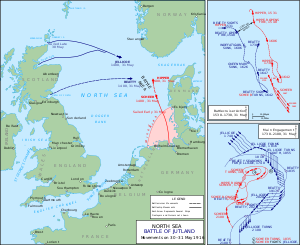
https://upload.wikimedia.org/wikipedia/commons/thumb/4/42/Map_of_the_Battle_of_Jutland,_1916.svg/300px-Map_of_the_Battle_of_Jutland,_1916.svg.pngFor two years, the British Grand Fleet and the German High Seas Fleet had, at best, played a dangerous game of tag with each other. The two navies engaged in small scale battles at places like Dogger Bank, but even then, the action was limited to cruisers and other smaller surface vessels. Since the beginning of the war, the mighty battleships of both sides as well as each side’s vaunted battlecruisers had either remained in port or far away from any gunfire.

On the one hand, it seems strange the two navies would be so reluctant to come to blows since, arguably, the German navy was one of the pivotal events leading up to the war in the first place. Since the decline of the Spanish Empire in the late 17th century, one thing was clear in all countries’ foreign policy — Brittania Ruled the Waves. The Royal Navy was unmatched in size, power, and victory by the time Kaiser Wilhelm II decided to build a German Navy. Britain was so focused on having the preeminent navy in the world she had enacted the Two Powers Act. This was a British law which demanded the Royal Navy be superior in size to the next TWO largest navies in the world COMBINED.

That wouldn’t have affected much in the rest of the world, BUT, the Kaiser wanted a navy to rival the Royal Navy. He’d spent a great deal of time around the ships of the Royal Navy, seeing as he and the King of England were first cousins, and he mightily wanted to emulate the grandeur of the Royal fleet. So he started building battleships and battlecruisers at a phenomenal rate. Britain saw this as literally an act of aggression on Germany’s part and so the first huge arms race of the 20th Century began.

Once each side had those glorious navies filled with dreadnoughts and battlecruisers, however, they were loathe to actually send them out. The reason for this reluctance is actually quite simple and economic. Those ships were called “capital ships” for a good reason; a tremendous amount of a nation’s capital went into their construction. Each ship was massively expensive and the last thing either the British or the Germans wanted was to engage in a huge ship on ship battle where they might lose one or more of these horrendously costly vessels. An old joke in navies around the world is the captain always goes down with his ship because it’s easier to die than face a board of inquiry.

All this feinting and dilly-dallying ended on 31 May – 1 June 1916 in the North Sea off the Danish peninsula of Jutland. For the first and last time in the war the Royal Navy and the Kriegsmarine would face off mano y mano and the result would be . . . inconclusive.

Much more brilliant minds than mine have authored scores of books about what happened to lead to the Battle of Jutland so this will only be a glance at an amazing subject but the gist of how the battle started is both sides thought they were leading the other side into a trap using parts of the fleet as bait. By the time everyone involved figured out the trap was mutual, both fleets were in parallel battle lines and as the saying goes, all Hell broke loose.

In a battle full of famous moments, one in particular which stands out is the fate of the British battlecruisers on the first day. Battlecruisers were an experimental ship at the time. Essentially, they traded armor for speed. They carried guns the size and range of the dreadnoughts of the time, but their armor protection was quite thin, especially over the deck. This thin top armor made the battlecruiser vulnerable to “plunging fire” as three British ships found out in rapid succession.

The battlecruiser squadrons of the two fleets made first contact. The Germans had the range advantage and were, though the British hated to admit it, better shots at sea. As a result, they quickly scored heavy hits on HMS Invincible causing her magazine to explode killing all but a bare handful of men. Not long after, HMS Queen Mary suffered a similar fate as heavy plunging shells detonated her magazines and sent her to the bottom. Later in the day during the famous “Run to the South” when the British battlecruisers tried to retreat to the safety of the main fleet, HMS Indefatigable suffered the now infamous magazine explosion destroying her and killing all but two of her crew of 1200.

Two other battlecruisers, HMS Lion and HMS Princess Royal narrowly missed similar fates and were saved from magazine explosions only by the heroic efforts of two Victoria Cross winning sailors who flooded the magazines at the cost of their own lives. The spectacular explosion of so many of the vaunted battlecruisers in such a short period of time prompted British squadron commander Admiral Beatty to remark, “there seems to be something wrong with our bloody ships today.” The second day would see the dreadnoughts take their turn in battle and though many delivered and received heavy hits, neither Britain nor Germany lost one of the major battleships.

By the end of the second day, darkness obscured the sea and the ships broke off attack. The Germans slipped away under cover of night and the British seemed more than willing to let them go. To this day, the Battle of Jutland is debated as to its effect on the war as a whole and even on who actually won the battle. Both sides claimed victory. The Germans lost eleven ships to Britain’s fourteen, and the British lost nearly 4000 more men, BUT the British still controlled the North Sea and could still effectively blockade any attempt to get food to Germany through those waters, which steadily increased the pressure on the German Homefront.

However, the heart of Germany’s fleet escaped. As long as the High Seas Fleet survived, it remained a source of constant worry to the British war planners. What the British could not know though is Jutland slaked Germany’s thirst for naval battles. She simply could not risk losing her ships while Britain had sustained incredible losses but still had more than enough naval power to meet Germany on equal footing. If the Battle of Jutland had one agreed upon result it was this — the German High Seas Fleet, pride of the Kaiser, would never again sortie from port. After Jutland, German naval policy would focus strictly on the U-boat, with dire consequences for both sides.

Love y’all and keep your feet clean.

So, I Just About Died Yesterday . . . For Reals

Standard

https://i0.wp.com/cdn.lolwot.com/wp-content/uploads/2015/08/20-facts-you-probably-didnt-know-about-scream-8.jpgI tell stories; it’s what I do — run my mouth or type fast as I can. Sometimes I embellish them a little bit just for flavor, but this one retelling needs no other elements than God’s honest truth. I almost died in a fiery car crash yesterday. You read that last part right. After spending the last three years and change separated from my precious little Mama and even longer separated from other beloved friends and family I almost rejoined them on the other side right near mile marker 22 on I-385 northbound.

Yesterday was Tuesday so as per schedule I was on my way home from visiting Granny at the nursing home in Clinton. It was a completely normal day. I was a little bummed that Granny hadn’t wanted to interact with me after her initial toothless grin of recognition, but she takes spells like that. I may go down next week and find her chattering away in her baby talk and we’ll have a conversation of sorts for an hour.

Anyway, back to the near death experience. I was clipping along in my ’03 Honda Element aka. “The Brave Little Toaster” with the A/C on max, listening to my tunes cranked up loud on my iPod, and just generally enjoying the bright sunshine. I had a semi truck in front of me, a big Ford truck behind me, and generally modest traffic scattered about here and there. All was moderately well with the world for a moment.

I should have known it wouldn’t last.

Just as I crossed the bridge at the WalMart Distribution Center where State 221 and I-385 cross, I felt a tickle on my right foot — my accelerator foot. I reached over with my left foot and scratched said tickle, but the tickle didn’t go away. Instead, the tickle transferred to the left foot around the front of my ankle. I was curious so I looked down; looking back at me was a spider somewhere between the size of my thumbnail and a dinner plate and it was taking a leisurely eight legged stroll up my left leg towards the open gap in my shorts.

https://i0.wp.com/www.ourbreathingplanet.com/wp-content/uploads/2014/10/136.png

A Goliath Bird Eating Tarantula posing with his pet crazy person’s hand.

One would not be remiss in saying I was somewhat troubled and chagrined by this completely unexpected situation. One would ALSO not be remiss in saying I momentarily but completely lost my @#$%ing $#%&. As far as I could determine, a Goliath Bird-Eating Tarantula had miraculously teleported from the jungles of South America to about eight inches below my left knee. Perhaps it was instead a deadly Southeastern Brown Recluse with the lethal white violin shape prominently on its back. Forgive me if I not only couldn’t be sure of the species of arachnid approaching an opening in my shorts, but I also DID NOT CARE in the moment.

All I knew for certain was a @#$%ing spider was crawling up my leg. Comparative Arachnology wasn’t in my stream of consciousness.

https://www.colourbox.com/preview/6956582-cartoon-caveman.jpg

Yeah, this guy was running the show.

Now thankfully, in the midst of such adrenaline fueled situations, the brain really shows its true worth . . .  not so much the frontal lobe, that’s pretty much shut down at the moment, but the instinctual parts of our grey matter which remember the times long ago when humans were just another item on the menu. That part of my brain took over and made me realize immediately I was in serious trouble. I could neither put on brakes nor let off the gas and use my right foot to remove the eight legged freak from my left shin. Had I slowed down so abruptly, the truck behind me would have run me over like Gravedigger at a Monster Truck Jam.

As it was, I started violently pounding my leg against the floorboard in hopes of dislodging the intruder. This caused me to swerve off the road at highway speed. I know I swerved off the road because the newly installed rumble strips made my teeth chatter. I jerked the wheel back to the left and almost overcorrected right into the Jane Mansfield Bar of the semi truck in front of me. The whole time, I’m doing a one legged cross between a Mexican Hat Dance and a Russian Sword Dance while thousands of cars and trucks around me are helping me concentrate by laying down on their horns.

Now let me pause here to address a question which has come up both times I told this story yesterday: “Why didn’t you just pull over and stop?”

Actually, that would have been an excellent idea but you must remember at the time I was mostly using the Og and Thag parts of my brain and cavemen don’t have really good grasps of the mechanics of driving a car; they are, however, excellent at the realization a @#$%ing spider was crawling up my leg. One must make due with the resources one has at the time and higher order thinking skills were up on a chair in the frontal lobe screaming like little girls.

Now, somehow, and I have no idea of the exact mechanism, all my gyrations managed to dislodge the a @#$%ing spider from my leg. That was the good news. The bad news was I knew neither where it fell nor what it’s immediate plans were. All I knew for certain was A) a @#$%ing spider was no longer crawling up my leg and B) I almost ate up the back end of a semi truck.

In the next thirty seconds or so, I started to breath a little normally. The frontal lobe came back online enough to get me moved to the back of the pack of traffic so I was no longer in immediate danger of causing a Talladega backstretch style of pileup on the highway. It is lucky that I did so because about thirty more seconds later, I felt that tell-tale tickle on my right leg again. This time though, I was prepared. I glanced down and flicked mini-Rodan off my leg with my left foot and he landed right next to that left foot as I put it down.

Now ladies and gentlemen, I am not a violent man. I love all God’s creatures except cockroaches, mosquitoes, and UGA football fans. I bear no real malice towards creepy crawlies like snakes and spiders. I feel in my heart everything on earth is just trying to get by as best as it can. Unfortunately for the spider now next to my left foot on the floorboard of the car, those gentle thoughts are the province of that pesky frontal lobe and not all of it had made it off the stool and stopped screaming like a little girl. Og and Thag were still pretty much running the show. As a result, I did not hesitate to stomp on that spider like he had said something offensive about my mother.

https://howthelightgetsinblogdotcom.files.wordpress.com/2013/11/squash.jpg

It was him or me.

I wiggled my foot around. I stomped three or four more times. I’d just seen a glimpse of the tunnel of light, my life had flashed before my eyes; therefore I was taking no chances. I turned that poor spider into spider mush and proceeded to drive on home still shaking a little bit. I pulled into the safety of my driveway and turned off the car. Then I grabbed a wad of napkins from the center console because, after all, the spider had been a valiant foe and deserved to be properly disposed of in the trash can . . . plus I didn’t want a zombie spider loose in my car.

As I bent down to collect the remains, I got a whiff of a terrible smell. It seemed to be coming from the spider carcass. I wiped him up and brought him up to eye level to examine him more closely. I can tell you with absolute certainty had he so much as twitched, I would not be writing this post as my heart had borne all it could in one day so I’m certain I would have passed out and split my head open on a rock and died there in the driveway.

https://i0.wp.com/www.pestworld.org/media/561857/brown-marmorated-stink-bug-from-side-white.jpg

And THIS is what it turned out to be. The antennae fooled me.

Luckily, that didn’t happen. Instead, I examined the spider remains. It wasn’t a wolf spider or a black widow. In fact, it turned out to not be a spider at all. It was instead a rather large example of the stink bugs which have taken over South Carolina the last few years.

That would’ve been nice to know thirty miles earlier!

Love y’all and keep those feet clean.

Thoughts On Motherless Day

Standard

https://s-media-cache-ak0.pinimg.com/736x/5d/8c/9c/5d8c9cd0dc0b81b8f98cb93ea17e0bb2.jpgI have a friend who was single for many years after all of her friends and most of her acquaintances had married. This young lady HATED Valentine’s Day with a purple passion. She called it “Universal Single Awareness Day.” She said the whole world spent weeks reminding her of her lack of a significant other and then rubbed it in her face every February 14th. I’ve since lost touch with her so I don’t know how her quest for couplehood ever turned out, but she was extremely bitter and bitterness isn’t conducive to great relationship success so I have no trouble believing she now has 20+ cats in a small bungalow somewhere.

Still, I understand her a lot better these days . . . especially today. It’s my third Mother’s Day without Mama and so far time has done a crappy job of healing this wound. It doesn’t help that Mama LOVED Mother’s Day. I always managed to get her a card with my own money every year until I started truly earning my own money and then I took Mother’s Day to the next level. I’d call her at the crack of dawn, take her to Waffle House to eat breakfast, give her her card, go to church with her, and take her to supper later on.

Getting married changed nothing because Budge was the daughter Mama always wanted. She doted on Mama every Mother’s Day as much or more than even I did. She would always arrange a mani/pedi for them . . . until Mama’s lungs couldn’t handle the harsh solvent odor in the store. Mama went from one card to three: one from me, one from Budge, and one from “both of us.” She kept every single card.

I know she kept every single card because I found them neatly arranged in chronological order in one of her deepest dresser drawers three years ago when I had to go through her stuff. She kept everything from the scrawling childish folded notebook paper and crayon all the way through the best Hallmark had to offer. I read two before I realized I’d probably lose my mind if I tried to get through any more so I pulled out the drawer and unceremoniously dumped almost forty years of love writ large into a large trash bag.

Now, every year, Mother’s Day is everywhere starting as soon as Easter ends. Every store runs specials. Every florist vies for the most beautiful commercial so we’ll buy their arrangements. Churches have special recognition services. Everywhere everyone is reminding me I no longer have a mother.

It’s crushing on Budge as well though she does a much better job of dealing with it than I do. In many ways it’s worse on her. She lost her own mother at fifteen and then had to endure losing the woman she called the greatest mother-in-law God ever created, but Budge has a special ache because we are barren. I have to deal with not having Mama. She has to deal with not having Mama AND not having children to celebrate her on this special day. I try to fill the gap, but she sees it for the weak attempt it is. Having no mother and no children I think are two of the hardest struggles my precious Budge has to endure.

We don’t go to the cemetery and visit graves though. My stepdad and I keep some sort of flower on Mama’s grave, but it’s a far cry from the huge arrangements others have on their departed loved ones’ headstones. I used to ache and agonize over not being able to afford an arrangement like those. I thought it meant I was a sub-standard son, but then I realized a lot of those flowers were making up for flowers never given in life. One of Mama’s favorite songs was “Give Me the Roses While I Live.” That’s what I tried to do, give her love and flowers while she was here to see and enjoy them.

Oh, and please, please, please to all my well-meaning Christian friends, don’t tell me my Mama is in a better place. It will make me want to hit y0u with a large blunt object for a few reasons. One, I know perfectly well Mama is in Heaven (at least on the days I’m not in a black hole questioning if any afterlife exists); two, I don’t want her in Heaven; I want her HERE hugging me so I can hug her back, so I can smell her and touch her and tickle her until she lost her breath; and three, I’ll never have a mother again because when we all get to Heaven our earthly relationships won’t be in effect anymore and we’ll be together, but she won’t be my little Mommy and I won’t be her Little Man ever again.

So keep the well-meant platitudes and bible verses behind your teeth today; they are cold, cold comfort compared to my Mama’s arms. I know that sounds horrible and I apologize but instead of the passing time making things easier . . . well, it’s just made it that much harder. I’m fighting a war in my heart and mind against becoming bitter about Mama’s death and, unfortunately, I seem to be losing. I guess it would be easier if she hadn’t died so young, hadn’t sacrificed so much for me, and hadn’t generally been the greatest Mama the world ever knew. I still love her fiercely and painfully.

Hug your mothers if you still have them and know you have my full sympathy if you don’t. Happy Mother’s Day to all the Mamas out there. I hope you get the love and attention you deserve today and every day as well.

Love y’all, and keep those feet clean.

Paisley Park is in Your Heart, Forever

Standard

I started listening to Prince at a seventh grade sleep over with Robby at my buddy Duane’s house when we hung out in his family’s RV, commandeered his older brother’s stack of slick covered magazines, and listened to Dirty Mind / Controversy until we fell asleep. The first cassette I ever bought with my own money was 1999. The first time I drove a group of guys around in my 1979 Ford Mustang on a Saturday night, my Purple Rain cassette provided the soundtrack for the evening with all of us singing along. Pretty much wherever I was as a teenager, the Purple One was riding shotgun. I reached for him when I was mellow, when I was excited, and when I was seriously sad, but never when I was angry because Prince didn’t write angry music. Just like his character in the movie Purple Rain, Prince was a lover, not a fighter.

Now he’s gone.

I found out yesterday when someone on Facebook posted “RIP Prince, you sexy MF.” I’ve been taken in by several dead celebrity hoaxes, so I held in the disappointment until I could get online and check out the reputable sources. MSN confirmed it with the “breaking news” headline reading “Superstar musician Prince dead at 57.” Cliche’ as it may sound, when I read that, a little piece of me died.

It’s been a rough year for me musically. First Bowie, then Haggard, and now Prince, but Prince seems the hardest to take because of the three, he most belonged to my generation. We were the ones destined to “party like it’s 1999,” which seemed so far away the first time I heard it. Prince was a large part of the voice of Generation X. 1999 was our middle school anthem, we started high school with Purple Rain, graduated with Paisley Park and went off to college with Sign O’ the Times.

He sang to us about us.

Prince’s music became the first stuff I had to hide from Mama, and most of my friends were the same way. We could get away with the double entendres of Little Red Corvette, but it was hard to mistake what he was talking about in the words to Darling Nikki, even if I did have to look up the word “masturbate” because that particular term hadn’t come up in everyday conversation by 1985 in my small Southern town. One of the best friends I ever had was actually named Nikki. We had first period study hall together my senior year and I loved to aggravate her with that song. All I had to do was hum the first few bars and she’d get all red in the face.

She’s dead now too, victim of a horrible DUI single car crash about 25 years gone. Whenever Darling Nikki runs through my mind out of the blue, I tell myself it’s her trying to communicate from The Beyond . . . nothing wrong with a little white lie to myself, after all.

Thing about Prince was his whole albums were good and not just the few singles which got the air time. In fact, my two favorite Prince songs I don’t ever remember hearing on the radio at all. I adore “Sometimes it Snows in April” off Under a Cherry Moon and my all-time favorite is “Starfish and Coffee” from Sign O’ the Times. Every one of his albums had not one but several un-aired hidden gems so I usually bought the cassettes as soon as they dropped so I could find them.Image result for prince

He was a strange duck in a lot of ways, of course, but — just like being able to pull off purple crushed velvet suits onstage — it was his plethora of quirks which made him so endearing to his fans. I remember when his record company tried to tell him he couldn’t use his own name for his own purposes so what did he do? He legally changed his name to a symbol that ASCII doesn’t reproduce anywhere I can find under any combination of keys. He went his own way, but he was always true to the music . . . always.

A big part of my younger self developed around listening to Prince and this world is a sadder, much less purple paisley place now that he’s gone.

So, remember I love y’all, keep those feet clean, and if the elevator tries to break you down — GO CRAZY!

Great War Wednesday: The Easter Rising 1916

Standard
https://sp.yimg.com/xj/th?id=OIP.M2ca6884d3f0c1aef1830efec1f2da747o0&pid=15.1&P=0&w=300&h=300

The Dublin General Post Office where the rebels headquartered.

The English and the Irish have hated each other for centuries. That hatred has ebbed and flowed from lows of simmering unrest to all out internecine warfare of the most foul and horrid kind over the long history of Anglo-Irish relations. One would have to search the annals long indeed before one could find a flare up of violence to quite match the bloodbath in the streets of Eire during the six days of Easter Week in 1916.

At the time of the rebellion, the rest of Great Britain, as we have noted for the last two years, was embroiled in desperate fighting on the continent in the midst of the Great War. Ireland at the time was under direct British rule, a fact which had chafed the proud Irish for as long back into the mists of time as Henry II. Though they had tried to throw off the English yoke several times before, never had they tried so hard, nor had England been so vulnerable as the massive Easter Rebellion.

The Rising began on Monday, April 24, 1916. Three Irish revolutionary armies — the Irish Volunteers, the Irish Citizen Army, and the Cumann na mBan — acted in accord and seized several British government buildings in Dublin and proclaimed Ireland to be a free and independent republic. Most notably, the rebels raised the Irish Republican flag over their de facto headquarters, the General Post Office in Dublin.

The British response was swift, harsh, and military. Many in England had started to soften towards the Irish over the decades since the last major rebellion in 1878 and the British Parliament had started working on several Home Rule Bills aimed at giving Ireland gradually more independence within the United Kingdom. Unfortunately, such goodwill evaporated in the face of what most saw as a rank stab in the back by the Irish nationalists when England was in the midst of dire straits.

The fighting centered on Dublin where British regular army troops by the thousands poured into the city and began nasty house to house fighting in a precursor to later 20th Century urban warfare. The further into the city center the solders got, however, the stiffer the resistance they encountered. Finally, the two sides formed a somewhat static front at one of the major city thoroughfares.

After the initial surprise of the Monday action, however, the rebels’ fate was sealed. The British Army, with two years experience on the Western Front, brought artillery to bear against the lightly armed revolutionaries. The provisional militias fought bravely and many of their actions are still sung today, but they had no way to counter the massive discrepancy in numbers or the artillery. As a result, by Friday, the Rising was over. The rebel leader nominally in charge of the coalition, schoolmaster Patrick Pearse, agreed to an unconditional surrender Thursday evening.

In the aftermath of the rebellion, over 3000 Dubliners — many who had nothing to do with the action — were rounded up and herded into internment or concentration camps to await trial . . . the use of concentration camps here and earlier during the Boer War enabled Adolf Hitler two decades on to blunt the English attempts to take the moral high ground near the outbreak of World War II by allowing the Germans in essence to say, “We got the idea from you!” The majority of the rebel leaders received swift courts-martial before being found guilty almost to a man, or woman, and were executed before the end of the year.

The political fallout of the Easter Rising proved enormous. For five decades the moderates in Ireland and England had been working towards a constitutional nationalism. That immediately gave way to martial law which stayed in effect long after the Rising ended. Many historians cite the Easter Rising as the opening round of the broader War of Irish Independence of 1919-1920 which would eventually lead to Britain giving in and granting Ireland, save for the Ulster counties, independence and the long sought Home Rule. Unfortunately, the situation in the Ulster counties would lead to a quasi-war between Britain and the Irish Republican Army which would last for decades and became known famously as “The Troubles.”

Probably the most famous non-political participant in the Easter Rising was famed Irish poet W.B. Yeats — incidentally one of my personal favorite poets. He wrote the following poem to commemorate the event.

Easter, 1916

I HAVE met them at close of day
Coming with vivid faces
From counter or desk among grey
Eighteenth-century houses.
I have passed with a nod of the head
Or polite meaningless words,
Or have lingered awhile and said
Polite meaningless words,
And thought before I had done
Of a mocking tale or a gibe
To please a companion
Around the fire at the club,
Being certain that they and I
But lived where motley is worn:
All changed, changed utterly:
A terrible beauty is born.

That woman’s days were spent
In ignorant good-will,
Her nights in argument
Until her voice grew shrill.
What voice more sweet than hers
When, young and beautiful,
She rode to harriers?
This man had kept a school
And rode our winged horse;
This other his helper and friend
Was coming into his force;
He might have won fame in the end,
So sensitive his nature seemed,
So daring and sweet his thought.
This other man I had dreamed
A drunken, vainglorious lout.
He had done most bitter wrong
To some who are near my heart,
Yet I number him in the song;
He, too, has resigned his part
In the casual comedy;
He, too, has been changed in his turn,
Transformed utterly:
A terrible beauty is born.

Hearts with one purpose alone
Through summer and winter seem
Enchanted to a stone
To trouble the living stream.
The horse that comes from the road.
The rider, the birds that range
From cloud to tumbling cloud,
Minute by minute they change;
A shadow of cloud on the stream
Changes minute by minute;
A horse-hoof slides on the brim,
And a horse plashes within it;
The long-legged moor-hens dive,
And hens to moor-cocks call;
Minute by minute they live:
The stone’s in the midst of all.

Too long a sacrifice
Can make a stone of the heart.
O when may it suffice?
That is Heaven’s part, our part
To murmur name upon name,
As a mother names her child
When sleep at last has come
On limbs that had run wild.
What is it but nightfall?
No, no, not night but death;
Was it needless death after all?
For England may keep faith
For all that is done and said.
We know their dream; enough
To know they dreamed and are dead;
And what if excess of love
Bewildered them till they died?
I write it out in a verse –
MacDonagh and MacBride
And Connolly and Pearse
Now and in time to be,
Wherever green is worn,
Are changed, changed utterly:
A terrible beauty is born.

Love y’all and keep those feet clean.

#TBT: It’s Springtime! Oh Joy, sniff, sniff, honk.

Standard

This originally ran on March 31, 2010.

It’s (sniff) springtime (sniff) and so (sniff) time to (sniff) begin my (sniff) love / hate (honk, blow, hack) relationship (sniff) with that (sniff) lovely stuff (sniff, honk) POLLEN (wipe, sniff)!!

All kidding aside, I do love springtime. Daffodils are one of my favorite flowers of all and a square foot of the delicious yellow blossoms still bloom every spring about this time next to the stone steps at Papa and Granny’s (now Aunt Cathy’s) just where Papa and I planted them some thirty years ago. The sky is blue as the bluest eye and the Final Four have been announced. It is spring!

Of course, that means it is hay fever season for me. I do not have allergies. That would be too easy. No, I have demon possessed nasal passages that twinge with the slightest micron of plant matter on the air. To put it simply, if it is green or has a bloom, I’m probably allergic to it. Violently, sickeningly, head-splittingly allergic to it.

From now until the first cold snap in October, my days will consist of bleary eyes and a runny nose. If you want some sound financial advice, invest in facial tissue. I predict a spike in the price of the good stuff as soon as I can get to the store. Budge mowed the yard tonight for the first time this year and I was picking up fallen limbs and other vegetable detritus of winter. We were outside probably ninety minutes at the absolute most. That was about three hours ago and one shower, two Claritin, and four Sudafed (the REAL meth-making stuff; not that knock off crap) later and I can finally sit still long enough to type a blog post. Of course, I have hypertension and Sudafed and Claritin do wonders for raising blood pressure so I’ll have a nice little raging headache for the next few weeks until my body adjusts its chemical soup for the change in seasons.

Of course, I am wildly overjoyed at the wonderful array of pharmaceuticals available to me and my fellow sufferers today. As a child, I had no such balm in my particular Gilead. Nothing then existed to blunt the misery of the spring, summer, and fall allergy season. The only medicine of any effectiveness was Benadryl. Now that is some wonderful stuff, but I had a choice — take Benadryl and spend summer in a coma, or take nothing and let my eyes swell shut and my nose become so raw it would literally ulcerate in some places. I tried to play outside with the other kids, but to be totally honest, I don’t do misery well, so I spent a lot of time indoors or in a Benadryl haze.

My horrible allergies deserve the most credit for all my academic achievements and the most blame for all my athletic failures. I’ve always been told I had a football player’s build, but it’s hard to block someone when your eyes are running rivers and you have to sneeze every fifteen seconds. (Just as an aside, you ever sneeze in a football helmet, you won’t forget it) On the contrary, I’m strangely not allergic to dust (mold is another story) so the dusty stacks of the local library branch were a respite from the yellow swirling air outside. The library was air conditioned as well, which was a nice bonus for a fat kid like me.

So, thanks to hay fever, I graduated second in my class in high school having never been able to play a game of football or baseball in my life. I love baseball. ***sigh***

Well, I’ve got to go blow my nose . . . again. So, y’all keep those feet clean and those pollen masks on and remember I love y’all and we’ll talk at you later.

Habeas Corpus

Standard

Today is Easter Sunday.

Today, Christians the world over celebrate the most important event in the history of the world — Jesus Christ’s rising from the dead. It is the the hinge event of the Western world. Before Jesus’ death and Resurrection, we talk about B.C. but after he rose from the dead, dating changes to A.D. It is a singular event.

I’ve had conversations with people of varying degrees of skepticism and the question inevitably comes up, “So what would it take for you to believe in the truth of Christianity?” I’ve gotten a great many answers but they all rhyme. Each one is a variation on the theme of “I would have to have proof of something absolutely miraculous.” More than once, my reply has been, “Um, a man who was scourged, crucified, DIED, had a big-assed spear shoved into his dead body, was wrapped like a mummy in pounds of linen strips, and sealed in a rock tomb before returning to life then stepping out of said tomb triumphantly three days later to begin 40 days of teaching during which time he was seen, felt, heard, smelt, and maybe even tasted by over 500 people before ascending to Heaven in front of hundreds of eyewitnesses isn’t miraculous enough for you?”

To this day, I’ve never had anyone say, “Yes.” They either stare a hole in the ground at their feet or they smile (or smirk) and say, “but that couldn’t happen.” EXACTLY! That’s why it’s called a MIRACLE! Unfortunately, the Resurrection is not only the most important event in history, but also the most ridiculed event in history as well. To adherents of other religions, including atheism and its current priestly triumvirate of Dawkins, Harris, and the late Hitchens, the idea that a man could — and did — rise from the dead is mythology akin to Prometheus being bound in the Caucasus Mountains or Odin and his offspring riding down the Rainbow Bridge from Asgard to fight Ragnarok.

I’ll tell you a truth about myself. I’m one of the worst Christians you will EVER meet. My life seems to be falling apart sometimes. I suffer from anxiety disorder and bouts of severe depression. I am not a poster child for the overcoming life of joy the Bible teaches we can have. In my dark periods — and they come more often than I feel capable of dealing with sometimes — I have wrestled with doubts. Does God really exist? Is there life after death? Where do we come from and where are we going and a thousand other questions that make me walk the floors of my home night after night. But, in my darkest nights of the soul, I return to one thing — the Resurrection accounts, and in those moments of soul-searing agony, one compelling and unanswerable detail has nailed me to my faith in Christ as surely as He was nailed to a Roman cross.

If Jesus of Nazareth did not raise from the dead, where is His body?

The founders of other religions of the world are accounted for. Gautama the Buddha was cremated and containers of his ashes given as relics to shrines. Confucius is interred in Qufu, China, his hometown. The Mohammad lies beneath the Mosque of the Prophet in Medina. Not only are they accounted for, no other religion even claims their founder 1) WAS God and 2) BODILY rose from the dead. Several, especially the more esoteric ones would have us believe their founders or other holy men “transcended” or rose “spiritually.” In any event, a body eventually gets buried, burned, or otherwise disposed of.

But wither the Carpenter of Nazareth? Where are the remains of He whom Pilate, a Roman provincial governor not prone to flights of superstition, named “REX IVDAEORVM” ? Where is the body of The Christ, the Holy One, the Son of God?

First, Jesus of Nazareth was a real person who died on a real cross at a real point in time in the very real and verifiable Roman province of Judea in or about 33 AD. Forget about “the search for Jesus” or “the historical Jesus”. We have the Gospels and they say He lived. We have Josephus and Philo and they say He lived. Still people want to dispute Jesus’ existence. To them I say, was Julius Caesar real? Prove it. Less material exists mentioning the would-be Roman emperor than mentions Christ by a magnitude of ten yet no one doubts Caesar’s life and deeds. Why must Christ’s life be called a myth? If we are going to play these reindeer games, let’s all play by the same rules for all historical persons.

So, where is His body?

The Resurrection DESTROYED the Roman Empire. Because the majority of the first Christians were Jewish, it made Jews, sadly, a cast out and hunted people. Logic dictates that if either the Romans or the Jews had knowledge of the location or were in actual possession of Jesus’ body, as soon as Christians like Peter started preaching in the streets, these men would have gone to a tomb, carted out Jesus’ body, unwrapped it and said, “Here is your ‘Savior'”. Does anyone think for a moment Christianity would have survived such a revelation? Would Peter and the other Apostles have bothered to die such horrible deaths as they did FOR SOMETHING THEY KNEW WAS A LIE?!

No. Christianity would have come to a swift end because our entire reason for believing rests on a BODILY RESURRECTED Jesus Christ. If Jesus was really just a “great teacher,” the movement his followers started at his command would have died in the cradle, not lived to become the largest religion in the history of the world.

But it didn’t.

Through reading I have settled on two unassailable facets of Roman life. First, the Romans were excellent record keepers. Second, the Romans were excellent killers. The Romans in Palestine who crucified Jesus didn’t “misplace” the body and they didn’t take Jesus down “alive” from the cross so that He “got better” then showed up later on. I don’t have the time or space to shoot those two arguments against the Resurrection as full of holes as they deserve to be, but luckily others have done that yeoman’s work in my place. My suggestion is to start with the thin book by Josh McDowell titled More than a Carpenter if you want to start exploring the arguments over the centuries around Jesus’ death and resurrection.
I must warn you, though, before you undertake such a journey. Many extremely passionate and intelligent men have set out to debunk Christianity’s claim that Jesus rose from the dead. None have succeeded and many have become believers and followers of Christ in the process.

Will you?

Love y’all and Happy Easter.

Why are you seeking the living among the dead? He is Risen, just as He said He would.

Great War Wednesday: Fear God and Dread Nought

Standard

HMS Dreadnought under full steam.

Every now and again something comes along so amazing, so revolutionary it causes a break in time. Much like Christ’s life, death, and resurrection divided history into BC and AD (or the more politically correct BCE and CE) an event or an invention splits our paradigm where everything gets sorted into before this event and after this event. In naval history, one of those history dividing moments came 10 February 1906 with the launch of HMS Dreadnought, the most modern and revolutionary battleship in the world.

In our modern era of overwhelming air power and its projection via aircraft carriers, we don’t think much about battleships anymore, but from the 1500s until 1920s, any country who wished to project power abroad did so with capital ships. Now to give a full history of naval design developments would take much longer than I have to write and you have to read so let me hit the high points. From the 1500s through the American War Between the States of 1860-1865, the primary weapons system of fighting ships anywhere in the world was basically the same: one or more decks of the sailing ship were lined with smoothbore cannon. The accepted tactic was for enemy ships to approach one another at ridiculously close range and blast away at one another until one combatant was reduced to splinters or sank. For nearly 400 years, sail and smoothbore reigned supreme.

Then came the aforementioned American War Between the States and four nearly simultaneous leaps forward in technology. Leap one was the decision to fasten metal plates to the wooden sides of ships, nascent armor.  Leap two was the introduction of steam power and the removal of sails, cutting the umbilical “wind cord.” Thirdly, the rifled cannon came into prominence enabling gunnery at huge distances.

It was the fourth innovation that would later set HMS Dreadnought apart forty years later. A little ship called the USS Monitor made her debut in the Battle of Hampton Roads Bay. She was ironclad, steam driven, and mounted rifled cannon. What was most interesting about her, however, was in an era where some ships carried 100 cannon, she only mounted two, but they were rifled and housed in a contraption called a turret. The turret rotated to give Monitor a 360 field of fire. She didn’t have to wait to come broadside of an opponent; she only needed to turn her turret to gain a shot at a target.

Now, turrets didn’t catch on all over the world overnight. Capital ships, especially battleships, continued to mount their main armament in broadsides with one or two turrets to assist the broadside but these turrets were mounted on the sides of the ship so their field of fire was limited. Battleships also carried several types of guns in different batteries throughout the topside of the ship. Each of these guns required its own special type of ammunition. It was not an efficient system by any stretch.

HMS Goliath, one of the “pre-Dreadnoughts” replaced by the all-big-gun design. Notice the secondary battery amidships.

Then Sir Jacky Fisher became First Sea Lord of the Royal Navy. He set down plans for a battleship with all big guns. Specifically, he wanted a massively armored ship mounting 12 inch naval rifles. Such a craft would be able to engage targets at the heretofore ridiculously long range of 14,000 yards. Royal Naval engineers went to work and the fruits of their labors was the paradigm changing HMS Dreadnought.

When she launched, Dreadnought was the most heavily armored ship in the Royal Navy and, by extension, the world. Despite her massive armor weight, she was also one of the fastest capital ships in the world with a sustained top speed of 21 knots. This speed was due to her innovative steam turbines, the first to be used in the Royal Navy.

What set Dreadnought apart most of all, however, was her main battery. She was the first battleship in the world that did not mount any heavy guns in static positions. Her main battery consisted of ten guns in five turrets of two guns each. Three of these were mounted down the centerline of the vessel, a first for battleship design. The other two turrets rode amidships, one to starboard and one to port. Unlike later “super-Dreadnoughts” which followed along soon enough, none of HMS Dreadnought’s turrets were stacked one atop the other, a situation called “superfiring.”  Although superfiring turrets would be de rigeur for all later battleships because of the superior field of fire thus available to all guns, at the time of Dreadnought‘s launch, no one was sure what would happen if a pair of 12 inch guns from a superfiring turret fired over a lower placed turret. One fear was the resulting muzzle blast would blow back into the lower turret and harm that turret’s crew.

Upon her launch, HMS Dreadnought made every other battleship in the world obsolete. She was much faster, possessed greater armor, and completely outgunned anything else on the high seas. Admirals and other naval officers the world over began referring to their present battleships as “pre-Dreadnoughts” and the struggle began to build Dreadnought style battleships in other countries as well, especially the newly consolidated German Empire.

In a way, Dreadnought helped bring about the Great War simply by her existence. All the other major naval powers had to start building their own new type battleships or risk falling perilously behind in technology. This started a major arms race all over the world. Germany in particular had long been jealous of Great Britain’s naval might and so embarked on a fool’s errand to duplicate the size of the Royal Navy. This escalation of the arms race lead to increased tensions between the two countries, tensions that later boiled over with several other factors to cause the First World War.

Ironically, the battleship that epitomized the class for the modern era never actually fired her guns in anger. The only clash between Great Britain and Germany’s battleship fleets was the famous Battle of Jutland in 1916, but at the time, HMS Dreadnought was in Scapa Flow being refitted with the latest technology. She never got into the war and ended up sold for scrap less than two years after the war to end all wars ended.

Love y’all and keep those feet clean!

One of Dreadnought‘s most famous descendants, the USS Iowa, which served in WWII, Korea, Vietnam, and Desert Storm firing her full main battery.

Goodbye, Conrack

Standard

https://i0.wp.com/www.publishersweekly.com/images/data/ARTICLE_PHOTO/photo/000/015/15537-1.JPGI seldom get emotional writing my little posts. In my creative process, most of what I’m going to say has been ground in the mill of my thoughts for hours or days maybe even weeks preceding my actually sitting down to write and in those times, the emotions come and tug and crush and draw their tears so once I sit down to churn out a post, I can do so relatively dry-eyed. I think it makes for better writing, but I may be wrong. In any event, my process deserted me this time. Three times since Friday I’ve sat down to write and three times I’ve had to leave my computer because the pain is just too raw. Today, I can finally make a go of it.

Pat Conroy, for years my favorite living author, died Friday, March 4, 2016 after a short bout with pancreatic cancer. He took part of me with him.

Tolkien taught me as a child to lose myself in fantasy and flee the monsters I could not fight but those monsters could and would be dealt with by someone stronger. Thomas Wolfe taught me the anguish of loving a place and a people with such fervor and passion the thought of losing them becomes unbearable. They were the authors of my childhood and adolescence. Pat Conroy was the author of my adulthood. He had his own lesson to teach.

In the novels he wrote from his own anguished heart and guided by his own often brutal experiences, I learned the monsters pretty much always win while the people and places we love so much poison us all to death in the end . . . but the monsters still need to be fought and the people and places will have our love even as they destroy us in the process because they are so often one and the same — monstrous people and monstrous places we love dearly all the same. He taught me heartache, pain, and crushing loss are inevitable, but we must face them honorably come what may, preferably with a sardonic smile on our faces.

Mr. Conroy was the rebel I always wanted to be. He was an author who could manage to piss everyone around him off — his school, his erstwhile employers, even his immediate family — and eventually have them all embrace him for showing them the truth about themselves. He never shirked from a fight no matter what the odds. He was hard-drinking and fun-loving and he was the most Southern writer since Faulkner. I read and adored everything he wrote because in his work I saw a glimpse of what I could be if I could just stop worrying about what people think and tell the truth.

I had the pleasure to meet Mr. Conroy in person twice. The first time was at a book signing for Beach Music at the now defunct Open Book in Greenville. I’d just had my first run-in with the powers that be in a school district because I had the temerity to want to TEACH Beach Music to their precious youth group members and tarnish their tender and innocent ears. I actually got to tell him the story even as the line behind me started sending out for rope and torches. I told him I’d considered writing him for his help and advice. He smiled from beneath that unruly shock of white hair and said, “Son, if I’d have tried to help you, you’d have ended up fired and I’d have made the front page for all the wrong reasons . . . again!” Ironically enough, I would be fired from that job a few years later for somewhat different reasons.

The second time I met him was at the awards luncheon for the South Carolina Association of School Librarians. The conference was in Charleston that year and the scheduled speaker had called that morning to stand us up. Luckily, one of the librarians on the awards committee was a personal family friend of the Conroys so she called his home phone on Fripp Island. Not only was he home but he was delighted to come speak to a crowd of librarians on NO notice. He left home immediately and was the keynote speaker at lunchtime. Watching him spin story after encouraging story with nary a note, I saw what I wanted to be, what I could be, if only . . .

I’ve taken each of my signed first editions down from the bookshelf and thumbed through them. It’s a mark of how well-known my love of Conroy novels is that my first edition of The Prince of Tides was the first anniversary present Budge ever gave me. Now, he’s gone.

Conrack, Will McClean, Tom Wingo, Jack McCall . . . whatever he chose to call himself in what he was writing at the time, he always had a story to tell. It was often heartbreaking, usually brutally so, but told in such a way that one never knew if the tears were from the pain of the character or the glory of the writing. He will be missed.

Love y’all. Keep those feet clean.

Great War Wednesday: They Shall Not Pass!

Standard

The battlefield of Verdun then.

The Battle of Verdun began 21 February 1916 in the early morning hours with the largest artillery bombardment in history up to that point. Over a ten hour period, around 800 German artillery pieces – 22 of which were battleship sized 16.5 inch supercannons – fired about 1,000,000 shells into a 58.9 square mile region with the French fort complex of Verdun at the rough center.

Those numbers are too staggering to take in as they are so I’ve worked out a little math, which I hate, to provide some scale for you to consider. The covering fire works out to around 16,000+ shells per square mile, but since some folks — myself included — have trouble visualizing a square mile, so I did some conversion to acres. We Americans LOVE our version of football (which has surprisingly little to do with the feet) so most of us have seen a football field. For my soccer friends internationally, the pitch is close enough to be of no consequence for this exercise. A football field is roughly three-quarters of an acre.

The bombardment of Verdun placed 26.5 high explosive shells — many the size of a Volkswagen Beetle — onto an area slightly less than the size of a football field.

So, picture a football field in your mind. Now place 26.5 shells onto it in a roughly even pattern and ask yourself one question: “Where would I hide?”

The Verdun battlefield today, scarred and shellmarked even 100 years on.

The bombardment lasted ten hours, but halted around six hours for several minutes. This was a ruse to lure the French defenders out into the open to help the wounded or collect the dead. Once the commanders figured enough men had climbed out of the trenches to make it worthwhile, the bombardment opened up again with full intensity.

The Germans advanced following the artillery prelude in a style never seen before. Instead of a mass of feldgrau moving across the pockmarked moonscape, the Germans — eerily forecasting the common units of the Second World War — moved out as squads of “stormtroopers.” Most squads had about ten men in them. The guy out front carried what I think is the most terrifying weapon on any battlefield at any time — a flamethrower. No one had used flamethrowers to this point. Following him were troops carrying not rifles but sacks of the “potato masher” grenades. The idea was a squirt of liquid fire would roust out some hapless French survivors and the ones the flame didn’t kill would get the grenades.

The tactics worked flawlessly that first day. Thousands of French defenders died with German losses totaling a mere 600.

The Germans advanced steadily throughout the remainder of February. They took the east side of the Meuse River as well as several wooded areas. Probably the high point for the Germans came when a small detachment of around 100 men used subterfuge and a tremendous amount of luck to capture the large fortress of Douaumont.

When March rolled around, however, the German plan to bleed the French white started to go awry. The main problem the Germans ran into was they expected their unprecedented artillery bombardment would have destroyed any effective French ability to mount their own artillery attack.

They were wrong.

In fact, most of the French artillery had survived the bombardment and as soon as Generals like Petain could catch their breath long enough, the “Black Butchers” as the Germans called the numerous French 75mm field guns began to beat a bloody tattoo upon the backs of the erstwhile attackers. At that point, Verdun became simply another in the long string of bloodbaths which passed for battles in the Great War. Attack followed counterattack all through the Spring and Summer. Several places changed hands many times. One small outpost village called Fleury swapped occupiers a total of 16 times in around a month’s time.

The death knell of the Germans at Verdun came on 1 July 1916 when the British launched their huge Somme Offensive and went sweeping across the German front to the north. This, combined with the successes of the Russian Brusilov Offensive on the Eastern Front demanded a movement of significant men and materiel from the Verdun sector to these other regions to prevent massive breakthroughs elsewhere.

Falkenhayn had gambled on the French getting too attached to Verdun which would allow his artillery to chew their infantry up. Unfortunately for him, he managed to get sucked in to his own meatgrinder. Rather than simply sitting back and bleeding the French, the cycle of attack and counterattack the Germans so earnestly desired to avoid settled in and once that happened, French morale, far from broken by the early German success soared as men like General Nievelle lead from the front in some cases. It was he who, upon seeing the success the Germans had in the early stages of the battle, issued the famous order which still rings down through the ages to us, “On ne passe pas!” They shall not pass!

The battle ended on 17 December 1916 with the Germans simply pulling back. They left behind 373,882 of their own dead along with 373,231 dead Frenchmen. Wounded, captured, and missing figures would drive those numbers even higher. For his failed gamble, the Kaiser would sack Falkenhayn as the Chief of the General Staff and replace him with the twin headed snake of Paul von Hindenburg and General Erich Ludendorff, the heroes of the Eastern Front.

“The Iron Harvest” of Verdun. Shells like these continue to explode and kill after all this time.

Verdun remains the longest battle in military history by some estimates. The final casualty rolls totaling nearly 1 million ensure it will remain one of the bloodiest as well. To this day, large portions of the land in and around Verdun are off-limits to all but special units of the French military who each year unearth thousands of “dud” shells which still have the potential to explode and wreak death and destruction 100 years after they first fell. In many ways, death not the least, Verdun lives on.

Love y’all and keep those feel clean!