
Sheep graze on the Vimy Ridge Battlefield today.
For a brief flaming moment early in 1918, it looked as though the Germans might take Paris and grab victory from the ashes of defeat, but alas, the Spring Offensive failed them. With the cream of their army spent and fresh American troops arriving by the shipload daily, the Kaiser’s once mighty army began a long fighting but inexorable retreat towards the vaunted last defense of German home soil, the Hindenburg Line. Once even that mighty redoubt was breached, the gig was up. The army was fighting, but barely, and it was irreparably broken. Revolution began breaking out in cities across Germany. Hindenburg and Ludendoff, the two generals at the top of the military hierarchy realized the war was lost and informed Kaiser Wilhelm II of this fact. Faced with this ultimate humiliation, the Kaiser abdicated the throne of Germany on 9 November 1918 and the German High Command asked the Allies for terms of armistice. Two days later, at 11:11, 11 November 1918 — the “eleventh minute of the eleventh hour of the eleventh day” — the Armistice took effect and after four and a half years of unprecedented slaughter and misery, all the guns fell silent on the Western Front.
The Great War was over. The War to End All Wars had itself come to an end.
Sadly, the grim lesson of the war didn’t affect everyone. Front line commanders knew an armistice would take effect on 11 November at at least 5:00 AM local time and yet in many, many places along the line, fighting kept up and even intensified. Sadly, in the six hours between the signing of the truce to its going into affect, men kept dying — now completely needlessly — all along the front as nations in the last gasp of the war grasped for some final shreds of territory to claim. Maybe they thought another 100 yards would make the carnage mean something but who can really know?
If the Great War changed the world, the peace which followed changed it at least as much. The Hapsburgs were ousted from the Austro-Hungarian Empire. That ancient edifice, last remnant of the Holy Roman Empire of centuries before, splintered into various countries including Austria, Hungary, Czechoslovakia and others. The Balkans, where the war began, consolidated into one country called Yugoslavia and laid the groundwork for generations of ethnic violence for decades to come. Poland, once wiped from existence, returned to nation status again and Russia started calling itself The Soviet Union.
Perhaps most affecting us today, the Middle East as we know it was created out of whole cloth as the Ottoman Empire shattered and was redistributed among the victors. France and Britain took up protectorates of the areas which now hold Syria, Lebanon, Palestine, Iraq, Kuwait, and all the familiar names we know from the violent news in our headlines today. The victorious powers drew national boundaries where none had existed before and split tribes in many places while combining the volatile factions of Islam into single countries in other places. The conflict in the Middle East today, bloody as it is, traces its origins to the chaotic end of World War One and the scramble for the mysterious new magical fluid — crude oil — that all the major powers now needed as if it were their own life’s blood.
For Germany, the end of the war was particularly cruel. Germany lost the heart of its industrial region — the Rhineland — to France, and was stripped of all her colonies as well as being forcibly disarmed. The monarchy was gone, replaced by the Wiemar Republic, a barely functional government that bravely but futilely tried to transition Germany from monarchy to democracy. Most grievous to German morale, Germany was forced to accept complete responsibility for the War. France and Britain both demanded heavy reparations from the broken country — payments that were draconian in both size and duration. Germany had to accept the label of “the bad guys” famously iterated in the clause in the treat which said Germany must bear sole responsibility for “all the loss and damage to which the Allied and Associated Governments and their nationals have been subjected as a consequence of the war imposed upon them by” Germany and her allies.
One problem developed immediately in the German psyche. Because Germany still had a capable army in the field when the war ended, many German radicals would protest that the country hadn’t actually been defeated. They claimed the military never surrendered but was instead “stabbed in the back” by the civilian government with the help of “Jews, Socialists, and Bolsheviks” who had no right to stop the war while Germany had the power to resist. This mythical “stabbed in the back” narrative would rankle in Germany for years and would find its ultimate fertile ground in the speeches and writings of a former Austrian corporal named Adolf Hitler.
The Treaty of Versailles which ended the war notoriously emasculated Germany. Her army was taken, her navy sunk en masse at Scapa Flow in Britain, her air force dismantled and forbidden to reform EVER. It was a treaty no self respecting country could ever bear up under and it was the conditions imposed by the treaty that led Field Marshall Ferdinand Foch to famously state, ““This is not a peace. It is an armistice for twenty years”. Ironically, the Second World War began twenty years and sixty-five days from the signing of the Versailles Treaty.
Well, I hope you’ve enjoyed the past four years of Great War Wednesday posts. I originally intended for there to be one every Wednesday, but as you can tell from the archives, that didn’t happen. Still, World War One was an immeasurably important point in world history, arguably more important long term than the larger and deadlier Second World War.
In any case, love y’all, and keep your feet clean.





 The Great War provided a plethora of ways a man could meet his Maker; some were even quite novel. He could take a rifle bullet to the vitals from across No Man’s Land, or even be riddled with rifle bullets from one of the new machine guns as he charged across the broken way. He could disappear into a fine red mist if an artillery shell landed in the midst of him and his buddies. A sudden gas shell attack could dissolve his lungs in his chest. Given the right terrain and weather, he could drown in sticky, soupy mud. He could even fall out of the sky, burning like a candle, in one of the new airplanes if his enemy got behind him or the ground fire was accurate enough.
 Today marks ten years since the first post I made on this blog. It’s easy to remember the day because my first post was about Labor Day and how it’s vital to teachers. I talked about teachers in many of my posts back then. Then, the blog name was “Books, Bytes, and Grocery Store Feet” because it was aimed at my colleagues — other school librarians. I had no way of knowing at the time, but 2008 would be my last year in education. Actually, it would be the last time I was in anything. After a lifetime fighting my mind, my mind finally won so I’ve spent the last ten years on the sidelines.



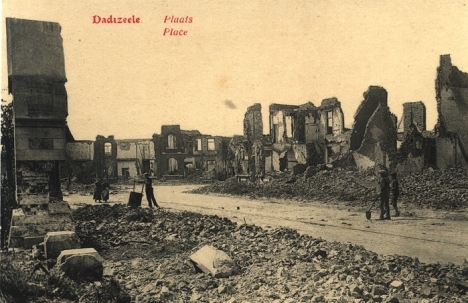 August 1918 proved a turning point in the Great War, in this case, the final turning point. The German Spring Offensive had begun with a roar in early May, but by July had managed to peter out with a whimper. It had managed to prove the war could become mobile again, but the cost was the cream of the German Imperial Army. At this point, the Entente forces realized the time was ripe for a decisive counter attack while Germany was at her weakest and most overextended. Thus began what we now call The Hundred Days or, so a not to confuse it with the “original” Hundred Days of Napoleon Bonaparte, The Hundred Days Offensive or sometimes The Advance to Victory.


 So, I shoehorned my double-wide rear end and equally broad shoulders into the stainless coffin, placed my cell phone within reach on the floor, and, forcibly cock-eyed on the seat by the idiotic placement of the T.P. dispenser, proceeded with, to quote Bachman-Turner Overdrive, “Taking care of business.”


 "Granny Beads and Grocery Store Feet"