 Now back at the turn of the century
in the clear blue skies over Germany
came a roar and a thunder like I’d never heard
it was the screamin’ sound of a big warbird!
Snoopy and the Red Baron by The Royal Guardsmen
Little more than a decade after the Wright Brothers made their famous flight at Kitty Hawk, some enterprising young French or British lad with a certain skill at piloting these newfangled “aeroplanes” convinced his commander to let him take one up just to “see what the Huns were up to over the hill.” The commander obliged and the daring young man in his flying machine returned a little later breathless and excited at all the amazing intelligence he was able to gather for his fellow soldiers. Obviously, some enterprising young German lad saw that “reconnaissance flight,” as did HIS commander so the youngster had little trouble convincing a nearby officer to let him go fly over the Allied lines. He went and came back safely, and so began the earliest use of airplanes in warfare.
Things went along splendidly for a few months with almost daily flights over the lines by both sides. The pilots were quite chivalrous with one another and usually exchanged a wave as they passed in the air. They were enemies on paper, but kindred spirits at heart. Then, one of the nastier young men figured it would be good if only HIS side were able to fly over and spy out the other side’s troop movements so this cretin carried a Lee Enfield or Mauser K98 up with him the next time he went aloft and instead of waving at his fellow recon pilot from the other team, he shot the guy with the rifle which, of course, the other man found quite unsporting and he complained about it bitterly to himself all the way to the earth whence he crashed and died.
The offended side, and I like to think it was the British for reasons which will be clear in a moment, thought this shooting at another plane was certainly NOT CRICKET! (see, only the Brits say that) They decided to one up Fritz and did so by sending up a plane with an “observer” in a rear seat. Now, this observer happened to have a Vickers machine gun mounted on a swivel in his cockpit and this machine gun made short work of the first German recon plane the duo encountered. Now the cat was well and truly out of the bag. Pilots had decided, mostly amongst themselves, it was open season on each other and the arms race took off, quite literally. I cannot help but admire these first air warriors. I am terrified to think of flying in the most modern airliner the world has to offer so the idea of climbing into a jumble of wires, wood, and cloth with an engine out front . . . usually anyway . . . is to me nothing short of madness.
At first, the most daunting task facing the early aircraft engineers was how to best arm the new “fighter” type planes. The rear facing machine gun was a start, but the chance always remained that an overzealous “backseater” might track a trailing plane too literally and end up blasting his own craft’s tail off with predictably disastrous results for him and his pilot. What was apparent to everyone almost from the start was the finest place for armament was on the nose of the airplane. With guns on the nose, the pilot could fly the plane and shoot the guns resulting in fewer men in the plane and less weight. The only drawback to guns in the nose was the particularly pesky problem of the propeller. Early attempts established what most suspected, any attempt to fire through the spinning prop would result in shooting one’s own prop to bits with more predictably disastrous results for the pilot and plane since planes before the invention of the jet engine tended to fly quite poorly without propellers.
The first attempt to remedy the problem was put forward by a Frenchman named Roland Garros. His solution was to place steel plating on the propellers at the point where a bullet would otherwise strike the wooden prop. This method did work. Mssr. Garros shot down three enemy planes using the steel plate technique, but it did have one nasty bug. If a bullet hit the steel plate at the right angle, it would not zing harmlessly to the side but instead came ricocheting back at the pilot seated behind the gun. Since the bullet traveled much too fast for the pilot to duck, he would usually end up shot in the head with, again, predictably disastrous results.
As luck had it, a German engineer of some renown, Anthony Fokker, (yes, let the puerile joking begin) got hold of a crashed plane with the steel plates on the prop and realized immediately what a truly stupid idea the whole thing actually was. Within a few weeks, he presented the German High Command with his masterpiece — the interrupting gear. This was an ingenious device that wedded the shaft of the propeller to the firing mechanism of the machine gun. Essentially, it had a “bump” on the gear wherever a blade of the propeller crossed the plane of fire from the gun. The bump would “interrupt” or lock the gun momentarily so the blade could pass unharmed.
Once a German fighter equipped with the interrupting gear crashed behind Allied lines, It didn’t take long for the British to get their hands on one of Fokker’s inventions even though the Germans tried like the devil to keep it secret. Once both sides possessed the ability to mount guns firing through the propellers of planes, the true age of fighter aircraft began as planes still famous today like Spad, Albatross, and Sopwith began taking to the air flown by men of equal fame like Buck, Rickenbacker, and von Richthofen. Air power was out of the cradle and by the end of the war would give glimpses of just how awesomely powerful airplane mounted weapons could be as well as how crucial control of the air would become.
More about all those in later episodes!
Love y’all and keep your feet clean.

 Any mention of The Blitz generally conjures up images of He111s and Ju88s dropping loads of bombs night after night out of a searchlight-crossed sky as the hardy residents of London sheltered, but not cowered, in the Tubes of the Underground and other “bombproofs” in the dark, uncertain days of 1940 and the Battle of Britain.
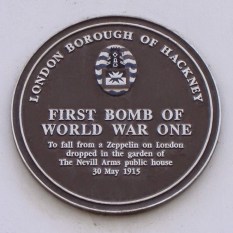 The very first bomb dropped on London by Zeppelin landed in a flower garden. The tendency for bombs to go off target led to mostly civilian casualties. Even though these deaths were unintended, the term collateral damage had yet to be invented. British press made propagandizing hay with every non-combatant’s death. Londoners referred to the giant airships as “baby-killers.”
 While Zeppelin raids went on right up until the Armistice in 1918, they must be deemed a colossal strategic failure. In the course of the war, airships made 51 bombing raids on England. These killed 557 and injured another 1,358 people. More than 5,000 bombs fell on towns across Britain, causing £1.5 million in damage. 84 airships took part, of which 30 were lost, either shot down or lost in accidents with an accompanying death of over 600 men.
 As a native South Carolinian, I know full well my little pie-shaped state by the Atlantic Ocean has precious little to show for its 489 years of European influence. To be sure, we started out well enough and early to boot. Spaniard Lucas Vazquez de Ayllon, founded the first European settlement in what would be the United States back in 1526. Called San Miguel de Gualdape and founded with 600 settlers, including African slaves, the little colony only lasted three months. I suppose football season ended. We were one of the original Thirteen Colonies, the First State under the Articles of Confederation, and the Eighth State to ratify the US Constitution. One could say we made a good beginning. Unfortunately, things began a steep decline from such august beginnings around 1860 and we’ve had trouble getting back on the rails ever since. We have no confirmed Presidential birthplaces within our borders, and no Presidential campaigns ever hinge on our bright red state. None of the Big Four professional sports has a team which calls our state home. No national parks beckon tourists even if the Grand Strand does.

 For example, if you are a cop and you shoot an unarmed man you were trying to arrest for non-payment of child support seven times IN THE BACK on VIDEO, we will not send the video to a lab and have it analyzed ad nauseum then convene a grand jury to figure out what should be done about you amidst much hand-wringing and moral agonizing. NO. Instead, we will fire you, take your badge and gun, charge you with first degree murder then THROW. YOUR. ASS. IN. JAIL! If some poor fool walks into a church and walks out later with an empty gun leaving behind nine dead worshipers, we aren’t calling “Reverend” Sharpton to come make a speech about how tragic the incident is while neighborhoods all across the state lose their minds and start burning police cars, smashing store windows, and looting everything in sight under the pretense of “being angry at the system.” Instead, we will pack out that church with people black, white, brown, red, pink, orange and green for every funeral. We will do what we always do for death in the South . . . mourn with those who mourn and send casseroles, pound cakes, and dry chicken to comfort the grieving.
 One of my all time favorite kids is turning sixteen tomorrow. She was one of my best customers back when I had a job as a middle school librarian and I wanted to do something for her special day, but as you can imagine, being out of work has seriously cut into the gift giving budget, so I sent her a card and enclosed a two page note that I wish someone had given me when I was turning sixteen. Maybe things would have turned out differently. Do you think I gave her good advice?
 I just tucked Budge in after an adventurous first day of Summer Vacation for her and the rest of the county’s teachers. Now I’m sitting here mulling over what would have happened if my plans hadn’t gang agley, as dear Robert Burns says. I know this much; if Plan F had managed to grow from seed to fruit, yesterday would have closed out my second full decade as a teacher. I was an emergency hire at Woodmont High School in October 1994 for the 94-95 academic year. A teacher who moonlighted at a retail store in the mall got a sweet promotion to full time district manager in another state and my resume’ was the one Dr. Susan Hoover-now-Achilles picked, I think at random, from a pile on her desk.

 That interview was a hoot.


 My life has slowly gone to Hell in a cheap Dollar General handbag for the last twelve years. It started with getting fired from Woodmont, but it’s steadily picked up speed until now I feel like I’m riding with a one way ticket on a runaway train, and to make matters worse, I haven’t had the foggiest idea why. I haven’t done anything that differently in my life, but stuff just keeps coming faster and faster and faster down the years. Now, I’m standing on top of my metaphorical levee, it’s leaking like a sieve, it’s going to break, and I know two things I didn’t know before: 1) This levee’s gonna break and 2) I know why. Let me enlighten you with what I’ve figured out.
 Next to my Mama, Granny Wham was the most formidable woman on this earth. She had an iron will that would not break even though it bent precariously a time or two, but she prayed Papa Wham home from Europe during World War II without a scratch on him and she prayed Daddy home from Vietnam without a scratch on him that anyone could see. If Granny Wham said she was going to pray for you, she wasn’t making idle talk. Your name was going on the list she would quietly and calmly review before her Lord every night before she went to bed. Everybody else on this page except for Budge and Granny Wham were all Pentecostal. Granny was a sprinkled Methodist turned dunked Southern Baptist Sunday School teacher and when she got on her knees she wasn’t talking to hear her brains rattle. She had every scrap of faith in the world that whatever she was praying for would come to pass no matter how improbable. Granny Wham was a serious prayer warrior.
 Blue Schofield Reference Bible laid out on the seat. She was praying and crying. I walked over and laid my hand on her back gently. She looked up towards me through pouring eyes and I asked her whatever was wrong. She said, “I had a dream I was in a wide open field and in the middle of the field was a mound of logs with a white sheet laying on it and as I walked closer to it I saw it was on fire, and when I got closer still I saw a body was under the sheet and it was on fire as well. Then I got right up to it and I was scared to pull back the sheet but I heard a voice telling me to.” Here she broke down for a minute and when she could speak again she said, “It was Frankie (my daddy). He was dead and burning and I don’t know what it means so I got up and came in her and I’ve been praying ever since.” When she reached a level of care need Cathy couldn’t give her at home, Granny moved to Martha Franks Retirement Center and even though a stroke left her barely able to speak intelligible words, God didn’t have trouble understanding her I know. Every time I went to see her, which was so very much less than it should have been, she was either napping in her bed or praying in her bed with her hands laying softly on the last bible I bought her to replace the Schofield that fell apart. Granny prayed.
 Papa John (Mama’s daddy) was a Pentecostal preacher and a loom fixer at a cotton mill. People laughed at him and ridiculed him and put him down as tongue tied and uneducated. They didn’t know the pain that seared Papa’s soul and mind. Papa fought his own personal demons all his life and even though they broke his body with multiple strokes and multiple heart attacks and a car wreck or two for good measure, they never broke his spirit. He preached God’s word on Sunday morning and Sunday night with all the fervor and fire of a John Wesley or Charles H. Spurgeon right up until he had a big stroke in the church parking lot that left him unable to speak above a whisper. People gave up on him and people thought he was odd and funny, but Papa never gave up on God. The last several years of his life, Papa couldn’t get out or get up much without help. Instead of watching the old westerns he loved with Roy Rogers and Lash LaRue, he’d sit from late afternoon until dawn with his father-in-law’s ancient family bible on his lap reading and praying, mostly for Mama and me. The last words I heard him speak were a prayer.


 Of all the issues I have to deal with, and believe me I have more issues than National Geographic, the most pernicious and debilitating is what I affectionately refer to as “The Tape.” That’s the short name. It’s full name is The Grievous Recitation and Replay of Misery, Misfortune, Doom and Failure Inside My Head. So, see, it’s much easier to just say “The Tape.”
 It’s all sitting up there waiting for the right time.
 Harder than it seems it should be, isn’t it? That’s an imaginary thought exercise. Try REAL events that resulted in REAL negative consequences, sometimes physical scars, and always emotional scars and pair them with a mind that doesn’t seem to have a “Delete” function and see what you can do. In short, it’s not like I WANT TO THINK ALL THESE THOUGHTS!! I am not a masochist. I don’t enjoy misery or pain, so if it was as easy as “just thinking of something pleasant” don’t you think I’d have done it already? Do you not realize how many times I’ve tried in over 30 years?
 By the spring of 1915, both sides in the conflict were desperate to find a way to break the stalemate on the Western Front because, while it hadn’t occurred to the top brass, others in and out of the military began realizing the carnage of the repeated forays into the meat grinder which was No-Man’s Land was ultimately unsustainable. The impetus for launching another front perforce came from outside the military because the highest generals in charge could not be swayed from their conviction that the sole path to Allied victory lay through the mud of France and Belgium. The idea came from a British politician, Sir Winston Churchill, First Lord of the Admiralty. He proposed a campaign that nearly cost him the rest of his political career, launched three nations forcibly onto the world stage, and ultimately proved no less bloody than the bloodiest battles along the Western Front. What Churchill proposed was an amphibious assault aimed at bolstering the flagging Russians and knocking the Ottoman Empire out of the war. The place he picked was a small peninsula in modern day Turkey called Gallipoli.


 The colonial soldiers of the French 45th and 87th divisions — mostly Moroccans and Algerians — must have been longing for home as dusk fell around 5:00 PM on April 22, 1915. The damp, muddy French and Belgian fields of the Western Front were a far cry from the hot desert sands of North Africa where most of the soldiers dwelt when not in service to their French colonial masters. At least this day was better than most; a light breeze blew into their faces from across No-Man’s Land. This was a change from the ordinary since the prevailing winds in this part of the world tend to blow west to east.
 "Granny Beads and Grocery Store Feet"