Category Archives: One in a Series

Seriously Embarrassing Moments I

Standard

Really shouldn't be playing FreeCell in church!

A great many people are surprised to learn that I am an ordained minister.  Strange as it may seem to those who know me, I, in fact, possess not one, but two ordinations.

In one of the churches Budge and I attended while courting, and for a long time after our marriage, I was an unpaid associate pastor and technical support. I knew more about computers and A/V technology than anyone else in the 200 member congregation so when tech issues came up, I was in charge of fixing them.

When I first started attending, we sang off the wall songs — literally. We had the lyrics printed on transparencies. During service, a praise team member would place a transparency on an overhead that projected the words onto a side wall of the choir loft. On a good day, the transparency would be the correct song AND in the correct orientation (i.e. not upside down or flipped so the words were mirror written.) In the name of progress, however, the church council decided to ditch the overhead and jump the digital divide by installing a first class media projector on the 50′ ceiling of the sanctuary and connecting this marvel to a computer in the back balcony.

Here my troubles began.

One of the duties of my ministry to the church was to run the PowerPoint presentation of songs that replaced the overhead sheets. I would flip back and forth between songs or between verse and chorus. I don’t know how many of you have ever attended a true Pentecostal service, but  if you go to a service and don’t know the words to the song, hymn, etc . . . don’t fret, you’ll know it just fine by the 17th time you sing it — while standing . . . and clapping.

The new system worked great during regular services. My conundrum came about the initial “First Sunday Night Singing” we used the new projector. Sunday Night Singing, for those who aren’t baptized in the Holy Ghost and Fire, is a once a month Sunday night service devoted to singing. We’d have solos, duets, the Ladies’ Ensemble and the Senior Men’s Quartet. You get the idea. I fixed up a set of slides in the order of the singers with the singer or group’s name. If I found out what they were singing, I’d put that underneath their names.

Because of that design trait, I almost got a double barrel blast of embarrassment because Dee and Kristie Gail were singing that first night. They are sisters from Harlan County Kentucky and universally known as “The Kentucky Sisters;” however, “The Kentucky Sisters” wouldn’t fit on the slide in the 125 point font I preferred so I decided to abbreviate it. As a result, I very nearly shot a slide onto the 15′ x 15′ screen in 8″ high letters that said, “The KY Sisters and ‘He Touched Me'”. It might have given Sister Molly Spell, the eldest member of the church, a heart attack . . . provided she knew what KY stood for besides Kentucky. At 92, I doubt it, but you never know. Anyway, I digress.

The singing was in full swing and I was changing slides every five to fifteen minutes depending on how much “the Spirit fell” during each song. During one of the longer stretches, I discovered the “FREEZE SCREEN” button on the projector remote control. To test it, I shot the projector and cued up the next slide and, sure enough, the monitor changed, but the screen didn’t! I thought I was in Fat City because, to be honest, it gets right boring alone in the balcony just pushing a button every now and again.

So, without another moment’s thought, I froze the screen and pulled up FreeCell — the King of Time Killer Card Games! I was on a roll that night. I’d won seven straight games and was immersed in game number 8 when I learned something about our particular model of Hitachi LCD projector — the “FREEZE SCREEN” function only lasts for 15 minutes at a time. After that, it releases and goes back to showing whatever is on the computer at the time. You haven’t lived until your FreeCell game suddenly appears behind the music pastor and his wife like Moses parting the Red Sea in DeMille’s “Ten Commandments”.

As one, the congregation turned towards the balcony. The shot only lasted MAYBE five seconds, but one can die a lifetime in five seconds. What’s worse, I could hear Sister Molly asking her granddaughter what was going on. Unfortunately, Sister Molly didn’t think her granddaughter had understood the aforementioned question and, being somewhat hard of hearing, she figured everyone else in the world shared her infirmity as well. So, with the church still silently stunned at the intrusion of the Devil’s handiwork into a worship service, and at the hands of the associate pastor no less, what did I hear loudly and clearly, along with most of the town of Fountain Inn a good twelve miles away?

“I SAID, ‘WAS THE YOUNG FELLER WINNIN’ OR NOT?!

The next Sunday, I noticed FreeCell had been deleted.

Love y’all!

Keep those feet clean 🙂

Coo coo ca choo, Mr. Brady!

Standard

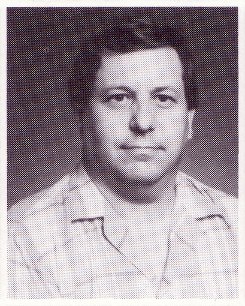
Mr. Brady circa 1989. He taught me Algebra II and Calculus. Finest math teacher ever.

Fate, if you believe in it, is an odd and capricious thing.

If Larry Brady had been able to fold proper paper airplanes, I would never have learned calculus in high school, so I would have been forced to take it in college — most likely with a thickly accented professor — and failed it miserably thereby not finishing my degree and likely dooming myself to a life of more misery and failure than I already have endured.

I guess one could safely say I owe a lot to Mr. Brady.

Budge and I were talking about math last night. Why, I don’t know. It’s one of those strange conversations married people have. Anyway, Budge HATES math. I blame Dad. Patience is not one of Dad’s cardinal virtues. He scarred her for life when he tried helping her with her algebra homework.

So we were talking about different kinds of math and Budge mentioned that she didn’t understand trigonometry. In about 15 minutes, I’d explained to her what it was, who used it, and why. I also gave her a rundown on mnemonics for the main trig functions. She wanted to know why it was so easy for me to learn and remember all this when she’d had such an impossible time with her high school math classes.

I answered her, “That’s easy; you never had Mr. Brady for a math teacher.”

As he explained to us in class in one of the precious few moments we managed to bump him slightly off topic, had Mr. Brady managed to conquer paper airplane origami at North Carolina State University, he would have pursued a degree and career as an aeronautic engineer. Unfortunately, he couldn’t get the hang of folding the paper the way this particular professor wanted it folded so he changed his major to mathematics and ended up, somehow, as a teacher. I’m not certain on the mechanism of fate, but I do know that fortuitous alignment of the stars resulted in a generation of math students at Laurens District 55 High School being blessed without measure by putting one of the most gifted instructors to every pick up a blue Marks-A-Lot overhead pen into the classroom.

Lest anyone reading this think Mr. Brady was so memorable because he was easy, happy-go-lucky, loosey-goosey, and tried being our friend, PLEASE get a grip. Mr. Brady had a dry sense of humor, genuinely enjoyed teaching, and loved three things above all else — basketball, math, and his two daughters, one of whom was my classmate.

He was friendly, but he was a teacher first. He was one of the most organized human beings I ever met — at least in the classroom. Most of all though, he was decidedly NOT an easy teacher. Earning Cs in his class was honorable, Bs were a sign of hard work, and As — well, As in Mr. Brady’s class were the Maltese Falcons of the LDHS55 math department.

What made Mr. Brady unique was his ability to teach any concept, no matter how abstract or outrageous, to anyone. I am convinced, within two semesters, he could teach a lab rat to play “Ode to Joy” on a miniature grand piano. He knew no less than five ways to do any problem. If, by chance, a brain-dead stoner in one of his classes couldn’t “get it” using one of those five ways, Mr. Brady didn’t get mad or frustrated — he made up a sixth way on the spot, just like he made up all his classroom examples — on the spot. Now, in case that doesn’t impress you, try making up a problem involving L’Hopital’s Rule on the spur of the moment to get an answer that is neat and easy to use as a teaching example.

He was amazing.

Lest anyone think Mr. Brady was one of those Ivory Tower Birds who could only teach the cream of the crop, be advised that he taught EVERYTHING in the math department. Remedial Mathematics to AP Calculus, he taught them all with the same passion and expertise. He was one of the minuscule fraction of teachers who could — and would — teach all students well and without complaint.

We spend a lifetime trying to forget some teachers. Others, we remember, but for all the wrong reasons. We recall many personalities, but precious little of the subject matter they once imparted to us. Mr. Brady wasn’t like that at all. I suppose the best way to finally impress upon you the man’s ability as an educator is to reveal that I made a 3 on the AP Calculus “AB” Exam at the end of his class. I can’t remember how many of us passed with a 3 or better, but it was a typically phenomenal ratio for his calculus classes. He taught me so well and so thoroughly that I still maintain some knowledge of calculus today — 21 years later — having never found a reason to use it.

The man was good. He was a teacher par excellance and I hope that, wherever he is today and whatever he’s doing (he’s retired, but that’s all I know), he’s reaping a generous reward for making two otherwise unbearable years a little brighter for me.

Good on ya’, Mr. Brady, wherever you are!

Love y’all and don’t remember to wash your feet.

Author’s Update September 6, 2006: When I first published this entry on my blog, I sent a copy to Mr. Brady’s daughter, Sally, to pass on to her dad since I didn’t know where he was living or any of his contact information. Sally wrote me back telling me how much she appreciated the tribute, but that she would be unable to pass it on to her father. Unbeknown to me, and to my great and lasting sorrow, Mr. Larry Brady — finest math teacher ever to pace the classroom — passed away in January of 2006 after a series of strokes. I had no idea.  Resquiescat In Pace, Mr. Brady, and thank you so much.

One in Every Town: The Prologue

Standard

The Heart of America = Small Town Main Street.

I’m a representative of a small town. I grew up in a dot (a very small dot) on a map off I-385 that existed only because of cotton and railroads. The town had a good cotton gin and the CSX railroad ran right next to main street, which was also State Highway 14. The gin and most of the farms that raised cotton were gone by the time I was old enough to know what cotton and cotton gins were. All that’s left of the old gin that was the heartbeat of the town is a square foundation with poles at the corners. It’s a great place to dig worms for fishing.

Towns like mine are the biggest part of our country. Sure, you’ve got your New Yorks and LAs, but for every big starred Atlanta, four or five Sugar Tits, Pleasant Groves, and Smithfields hold down their dots on the Rand-McNally.

In the South, we have a lot of textile mill towns. Back when “Made in America” meant actually created here instead of just assembled here from foreign parts, the South was the largest exporter of textiles in the world. Many bales of cotton rolled into one end of a plant only to emerge as miles and miles of cloth on the other end. Of course, once NAFTA and its corollary bills passed back in the ’80s and ’90s, the plants and mills started shutting down. It’s hard to compete paying $15 per hour to American workers when Mexican workers would do the same job for $15 a week. Of course, in a bit of irony, the Mexican factories that took the textiles from the South are losing their $15 a week jobs to Chinese who thing $15 a month is a royal wage.

The textile South isn’t the only small town area that’s hit hard times. The Rust Belt has small towns around steel mills and those mills started dying in the ’70s to cheaper foreign metal. Still, lots of small towns all across the country are holding on. Mining outposts in the West, farming towns in the Midwest bread basket, cattle towns in Texas and elsewhere. They are all places where life moves a little slower and things haven’t change much in many years. It’s the fishing towns on the coast and the orchard towns in the Citrus Belt that join the remote northwestern logging towns in making up the backbone of the country.

But what all these towns have in common is a set of individuals making up their population. Each has a cast of characters just as varied, but at the same time as predictable, as a Shakespearean play. I want to introduce you to some of them whom I grew up with and whose analogues can be found in pretty much every small town from Maine to California, Washington to Florida and all point in between. Look for them in some of my next posts.

Until then, keep your feet clean and remember who loves y’all!